Earthenware vs Stoneware vs Porcelain: How to Choose
Earthenware vs stoneware vs porcelain differs chiefly in water absorption: earthenware absorbs over 3% by weight, stoneware no more than 3%, and porcelain no more than 0.5%. These are classification thresholds, not guarantees for every piece, and firing ranges overlap, so cone number alone can’t identify a clay body.
Quick answer
What’s the difference between earthenware, stoneware, and porcelain?
Earthenware is the more absorbent, low-fire option, stoneware is typically opaque, and porcelain is usually fine-grained, white, and sometimes translucent. Classification thresholds are over 3% absorption for earthenware, no more than 3% for stoneware, and no more than 0.5% for porcelain. For everyday dishes, start with properly matured stoneware or porcelain, then check the specific piece’s condition and care instructions; choose earthenware for uses that suit its higher absorption.
- Earthenware: Choose it for terracotta or other uses suited to a more absorbent body.
- Stoneware: Consider it for functional pottery when properly matured.
- Porcelain: Consider it for functional pottery when properly matured; its firing range can overlap with stoneware, so cone number alone doesn’t identify it.
- For food or appliances: Check the maker’s guidance for the specific piece; type alone doesn’t establish food safety or dishwasher, microwave, or oven suitability.
How clay body and firing change each type
Earthenware is usually fired at cone 06–2, while stoneware and some porcelain bodies are fired at cone 3–7 or cone 8–10. These are broad studio ranges, not fixed boundaries, and stoneware and porcelain can share firing ranges.
Firing a body to maturity helps it become denser and less absorbent, but the result depends on its clay recipe and firing. Those thresholds classify ceramic ware; they don’t guarantee the absorption of every studio-made piece.
- Earthenware: These bodies commonly contain iron and mature at low temperatures; their fired color varies with the clay and its iron content. The fired body is typically more absorbent than stoneware or porcelain.
- Stoneware: This is generally a high-fired, clay-rich body with fluxes such as feldspar. It’s naturally opaque and often fires to buff, gray, or brown.
- Porcelain: Traditional porcelain is a fine-grained body commonly made with kaolin, feldspar, and silica or quartz. It’s typically white and may be translucent.
Cone number alone can’t identify a body: composition matters alongside firing because stoneware and porcelain ranges overlap. Porcelain’s body ingredients and resulting properties help distinguish it, while a body’s maturity affects its density and strength.
Treat these ranges as guides, not recipes: clay composition, particle size, firing temperature, and kiln atmosphere can all change the finished body’s appearance and feel. Grog or other additions can make it coarser, and porcelain can be less forgiving to form and more prone to warping during firing.
What each pottery type looks and feels like
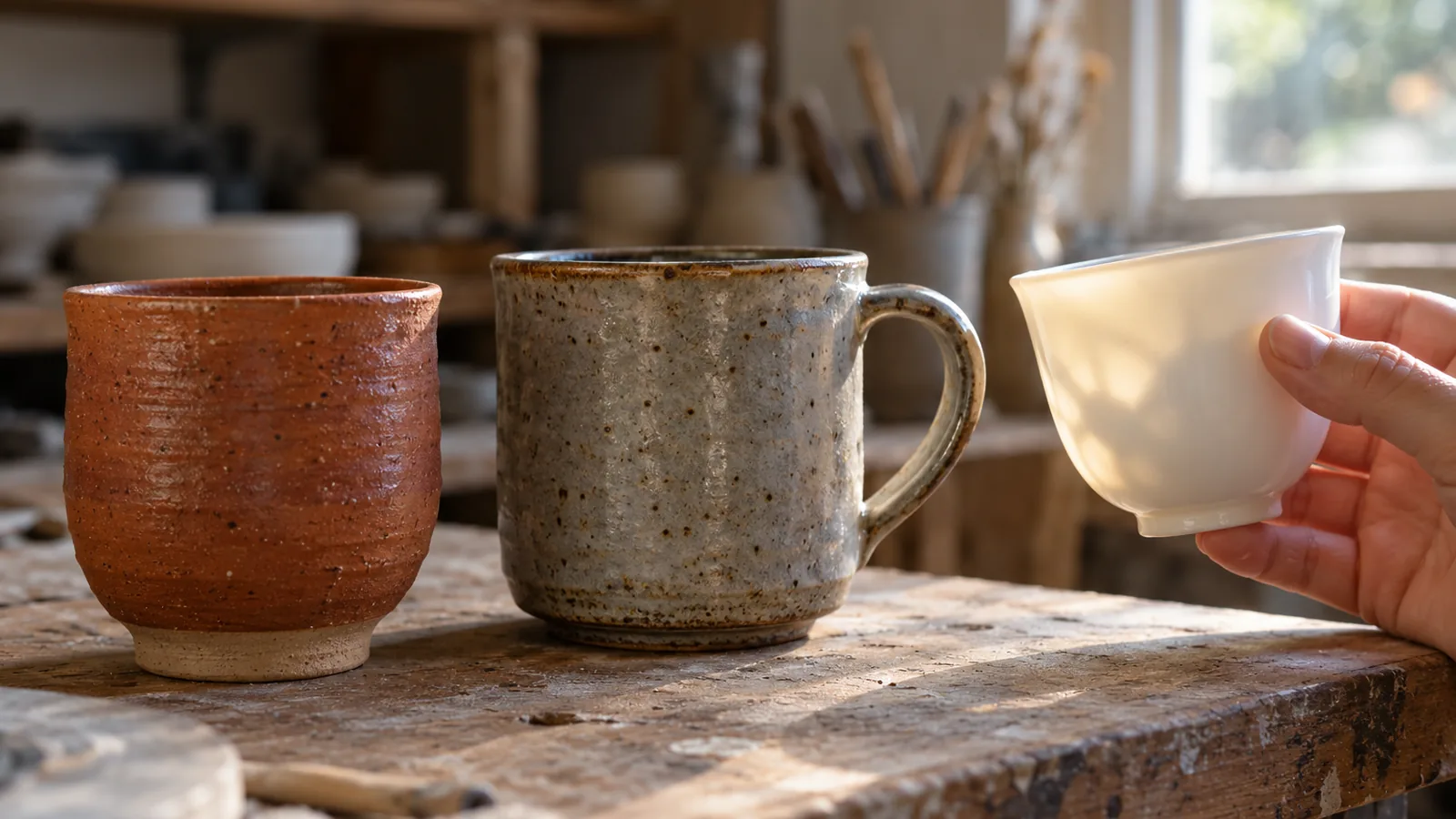
Earthenware, stoneware, and porcelain usually differ in color, texture, weight, and translucency, but those clues can’t identify every piece with certainty. In an earthenware vs stoneware vs porcelain comparison, look at the clay body itself, not just the glaze.
- Earthenware often fires to a warm red, orange, or brown, especially when its clay contains iron. Other clay recipes can produce different colors, so a pale piece can still be earthenware.
- Stoneware is usually opaque and often buff, gray, or brown. Its clay-rich body may feel less fine than porcelain, but grog, a gritty material added to clay, can make any body feel coarser.
- Porcelain is typically white, fine-grained, and smooth, and thin areas may let light through. Its fine texture can make it harder to form, and it can warp during firing.
Weight is a less reliable clue: the references don’t establish a standard weight difference among the three types. A piece’s thickness and shape affect how heavy it feels, so don’t identify the clay from weight alone.
Surface feel and color can shift with the clay recipe, particle size, forming, firing temperature, kiln atmosphere, and added materials. Glaze can change the surface appearance, but it won’t reliably tell you what the body is made from. If you can inspect an unglazed foot or broken edge, the exposed paste gives you a better clue than the glaze.
Color and texture are clues, not proof. Stoneware and porcelain firing ranges can overlap, so appearance alone may not settle the identification; the body composition and resulting properties matter too.
Which pottery works best for your use
Stoneware or porcelain usually works best for functional dishes, while earthenware suits pieces where its higher absorbency and care needs fit the use. Stoneware and porcelain can be dense and strong when properly matured, but the category name alone doesn’t guarantee durability.
Choose by how you’ll use and care for the piece:
- For everyday dishes: Consider stoneware or porcelain, but check the finished piece’s condition and the maker’s care instructions. Water absorption and glaze condition matter, and a stoneware label alone doesn’t prove the body is fully vitrified.
- For decorative pottery or terracotta: Earthenware can be a good fit, but its fired body is typically more absorbent than stoneware or porcelain.
- For dishwasher, microwave, or oven use: Check the maker’s guidance for the specific piece. The pottery type alone doesn’t establish that it’s safe for any of these appliances.
- For food and drink: Judge the finished piece, including its firing, glaze performance, and surface condition. The ware type alone doesn’t establish food safety, which also depends on whether lead or cadmium can migrate into food.
Care depends on the finished piece, so follow the maker’s instructions rather than assuming all items in one category can be treated alike.
If you’re concerned about lead exposure, verify the maker or have the pottery tested. Don’t use a piece marked “Not for Food Use” for food or drink; appearance, glaze color, shine, and a “lead-free” claim don’t by themselves establish whether harmful substances will leach.
Compare earthenware, stoneware, and porcelain
Clay composition and firing shape the appearance and performance of earthenware, stoneware, and porcelain. Use the table as a guide, not a guarantee for an individual piece: firing ranges are broad, and absorption thresholds are classification limits.
| Type | Firing range (cone) | Water absorption | Typical appearance | Durability and common uses |
|---|---|---|---|---|
| Earthenware | 06–2 | Greater than 3% | Color varies with clay and iron content | More absorbent body; used for terracotta and glazed tableware |
| Stoneware | 3–10 | No more than 3% | Usually opaque, often buff, gray, or brown | Can be dense and strong when properly matured; common functional pottery |
| Porcelain | 3–10 | No more than 0.5% | White and translucent | Can be dense and strong when properly matured; common functional pottery |
The ranges for stoneware and some porcelain bodies overlap, so firing temperature alone can’t identify either type; body composition and resulting properties also matter. Color and texture are clues, not proof, since clay recipe, forming, firing, and kiln atmosphere can change how a piece looks and feels.
Frequently Asked Questions
Which is more durable, stoneware or porcelain?
Neither has a universal durability advantage: properly matured stoneware and porcelain can both be dense and strong, and durability depends on the finished piece. Check the body’s maturity, glaze condition, and care guidance rather than relying on the ware label alone.
Is porcelain a type of stoneware?
No. Porcelain is classified separately from stoneware, though their firing ranges can overlap. Porcelain is typically a fine-grained, white body that may be translucent, while stoneware is naturally opaque.
Are earthenware, stoneware, and porcelain all food-safe?
No. Food safety depends on the finished piece, including its firing, glaze performance, surface condition, and whether lead or cadmium can migrate into food. Use the maker’s guidance, and don’t use pottery marked “Not for Food Use” for food or drink.
Can earthenware go in the microwave or oven?
Check the maker’s instructions for the specific piece; earthenware’s category alone doesn’t establish microwave or oven safety. Its fired body is typically more absorbent than stoneware or porcelain, so check the care rules for each type.
How can I tell if pottery is safe for food?
Check that the maker identifies it for food use and follow the care instructions; appearance alone can’t establish whether lead or cadmium will leach into food.
Conclusion
If you want an everyday dish, start with stoneware or porcelain, then check the specific piece’s condition and care instructions. Choose earthenware when its look suits your project and you’re prepared for a more absorbent body. For pottery you’ll use with food or appliances, confirm the maker’s guidance and assess the finished glaze and surface.
Sources
- Harmonized Tariff Schedule (hts.usitc.gov)
- ceramicartsnetwork.org (ceramicartsnetwork.org)
- ceramicartsnetwork.org (ceramicartsnetwork.org)
- digitalfire.com (digitalfire.com)
- ceramicartsnetwork.org (ceramicartsnetwork.org)
- ceramicartsnetwork.org (ceramicartsnetwork.org)
- usitc.gov (usitc.gov)
- fda.gov (fda.gov)
- fda.gov (fda.gov)
- digitalfire.com (digitalfire.com)
- ceramicartsnetwork.org (ceramicartsnetwork.org)
- floridamuseum.ufl.edu (floridamuseum.ufl.edu)