Polymer Clay vs Ceramic Clay: Which Should You Choose?
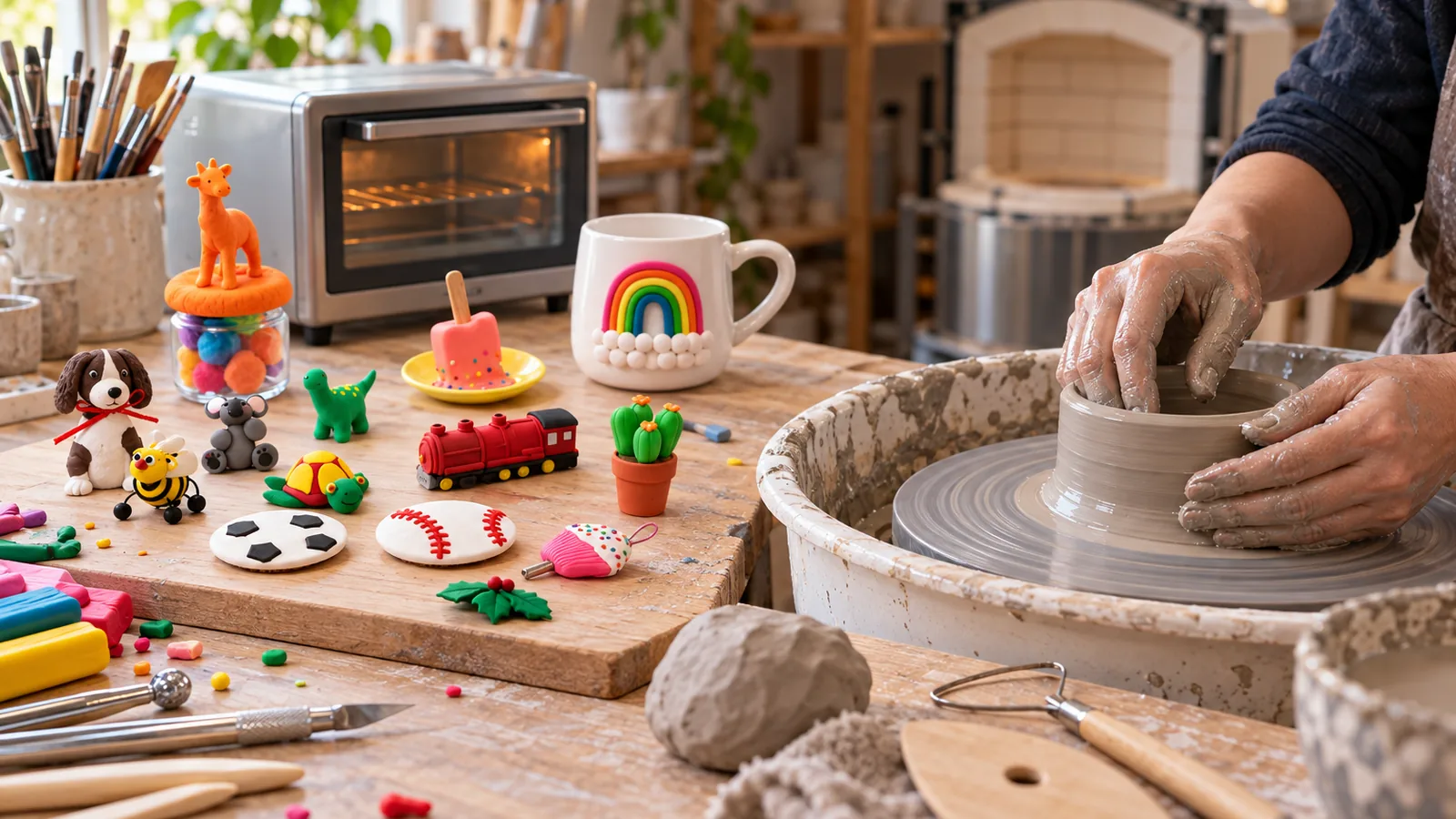
Polymer clay stays soft until you bake it, usually at 275°F (130°C) for 15–30 minutes per 1/4 inch of thickness. Ceramic clay is shaped with water and kiln-fired to its body’s maturity range. Use polymer clay for modeled pieces you bake, and ceramic clay for work you shape wet and fire in a kiln.
If you need functional food or drink ware, choose another material. Polymer clay isn’t recommended for food contact, even when glazed. A glaze coat can’t replace the right clay and curing process.
Key Takeaways
- Baked at 275°F (130°C): polymer clay stays soft until cured, while ceramic clay needs kiln firing to its body’s maturity range.
- Choose polymer clay for small sculptures: it stays workable until baking, making it suited to detailed decorative pieces.
- Choose ceramic clay for functional ware: polymer clay isn’t recommended for food or drink contact, while ceramic food safety depends on the body, firing, and glaze.
- Ceramic clay costs under $1.20 per pound: the listed bodies range from $0.84 to $1.16 per pound.
- Ventilate during polymer baking: overheating PVC-based clay can release fumes that irritate the eyes, nose, or mouth.
Can Polymer Clay Replace Ceramic Clay?
Polymer clay can replace ceramic clay for many sculpted and detailed projects, but it can’t replace ceramic clay for functional fired ware. The two materials harden in different ways.
Ceramic clay is a water-workable mineral body, while polymer clay stays soft and pliable until you bake it. Ceramic pieces are shaped while the clay is workable, dried, then fired in a kiln to the maturity range specified for that clay body. Polymer clay is conditioned for shaping and oven-cured, so it doesn’t follow the drying and kiln-firing process used for ceramic ware.
Choose ceramic clay when you need a piece made from a fired clay body; polymer clay does not go through that process.
Polymer clay can be a better fit for small sculpted forms, figurines, and decorative projects. It remains workable until baked, which lets you shape details before curing the piece. That makes it useful for projects where you want a modeling material rather than a water-workable body that must be dried and kiln-fired.
Choose based on the finished object and the tools you can use: ceramic clay for wet shaping and kiln firing, polymer clay for modeling and baking.
Where Do Polymer and Ceramic Clay Differ Most?
Polymer clay and ceramic clay differ most in what they’re made of and how they harden. Polymer clay is oven-cured; ceramic clay is kiln-fired, so their temperatures and finished properties aren’t interchangeable.
| Difference | Polymer clay | Ceramic clay |
|---|---|---|
| Composition | Plastic-based modeling clay | Water-workable mineral body; may include feldspar and silica |
| Hardening | Stays soft until baked | Shaped with water, then fired |
| Temperature | Usually 275°F (130°C) | About 900–1280°C for stoneware firing |
| Ceramic maturity | — | Low-fire cone 06–04; mid-fire cone 4–6; high-fire cone 8–11 |
| Mature-body water absorption | — | Stoneware 2–3%; porcelain 0–1%; earthenware 8–12% |
| Water resistance without glaze | Water-resistant after curing | Depends on body; mature stoneware and porcelain absorb less water than earthenware |
The temperatures measure different processes, so don’t read the lower polymer bake temperature as a measure of heat resistance. Ceramic firing brings a clay body to its maturity range, while baking hardens polymer clay.
How Do You Cure Polymer and Fire Ceramic Clay?
Baking Polymer Clay Without Brittle Pieces
- Check the package for the product’s baking temperature and time. Follow those directions, since the right settings vary by polymer clay.
- Preheat your oven to the package temperature before baking.
- Place the piece on an oven-safe surface and bake it for the specified time.
- For a thick piece, bake for 15 minutes first, then add time in 5-minute increments.
- Let the piece cool before handling it. If it breaks easily, underbaking may be the cause, so check the package directions before making another piece.
- Warning: Don’t guess at the baking time or temperature. Underbaked polymer clay can be brittle and break easily.
Kiln-Firing Ceramic to Maturity
- Identify the clay body and its recommended firing range before loading the kiln. The fired result depends on the clay, glaze, and firing conditions.
- Shape and dry the ceramic piece before firing. Ceramic clay is worked with water and hardened through kiln firing.
- Apply glaze if the piece needs a glazed surface, then load it for firing according to the clay and glaze requirements.
- Fire the piece to the clay body’s maturity range. Vitrification, the process that fuses clay into a glass-like state, affects the finished body’s strength and absorption.
- Allow the kiln and fired ware to cool before unloading. Check the surface and body after firing, since the clay, glaze, and firing all affect the result.
Maturity matters: Vitrification also affects durability, so firing temperature alone doesn’t tell you how the finished ceramic will perform.
How Do Food Contact and Dust Risks Differ?
Water, Food Contact, and Glaze
A glaze coat does not make a polymer clay piece waterproof. The maker also does not recommend polymer clay for food or drink contact, even when it’s glazed, because it hasn’t been tested for that use.
Ceramic pieces are different, and water tightness depends on the clay body. A fully matured, vitrified stoneware body may be waterproof on its own. Porous earthenware generally needs a glaze to hold liquids.
Ceramic isn’t automatically food-safe, though. Food safety depends on glaze fit, firing, and whether lead or cadmium can leach out of the glaze. The FDA advises against using pottery for food when its safety can’t be established, especially traditional or decorative pieces. For everyday mugs and bowls, choose a fully matured stoneware body and confirm the glaze is food-safe before you use the piece.
Silica Dust, Fumes, and Ventilation
Ceramic clay and many glaze materials can contain crystalline silica. Breathing in respirable crystalline silica dust can cause silicosis and other serious disease. The recommended controls are:
- Local exhaust ventilation: captures dust where it’s produced.
- Wet methods: keep clay and glaze dust damp as you work.
- HEPA vacuuming: cleans up dust with a HEPA-filtered vacuum.
- No dry sweeping: avoid dry sweeping and compressed air, which send dust into the air.
Polymer clay carries a different hazard. Overheating PVC-based polymer clay can release fumes that irritate the eyes, nose, or mouth. Ventilate the room while you bake, since the maker advises ventilation during baking.
Which Clay Fits Your Budget and Working Style?
Your budget depends on whether you buy in bulk and whether you plan to fire or bake your work. Your budget depends on whether you buy in bulk and whether you plan to fire or bake your work.
| Buyer | Product | Price (USD/lb) |
|---|---|---|
| Beginner potter | Common ceramic clay body | $0.84 |
| Functional maker | B-Mix 5 ceramic body | $0.92 |
| Functional maker | Cone 6 porcelain | $1.16 |
| Budget hobbyist | Original Sculpey Oven-Bake Clay | $11.99 |
| Sculptor | Premo + Soufflé 24-pack | $24.05 |
| Sculptor | Single Sculpey Soufflé bar | $92 |
Chart of the table above.
Ceramic bodies stay under $1.20 per pound in this listing, so they’re the clear pick if you’re on a tight budget. Original Sculpey is the lowest-priced polymer option listed.
Sculptors pay the most, and the 24-pack alone runs about $24.05 per pound. Premo and Soufflé are very strong and durable, though no strength numbers support that claim. You can store and reuse leftover clay without it drying out.
Frequently Asked Questions
Is polymer clay strong enough for everyday objects?
Yes, for decorative and light-use pieces, as long as the piece is fully cured. The manufacturer describes Premo and Soufflé as very strong and durable. Underbaked clay is the usual cause of breakage, so follow the package bake time.
Does unused polymer clay dry out between projects?
No, unused polymer clay stays soft because it doesn’t harden in air. It remains pliable until you bake it.
Can you mix polymer clay and ceramic clay together?
No, the clays should not be mixed and fired together, but they can be combined in one piece by adding polymer details after the ceramic base has been fired. Ceramic clay is shaped with water and kiln-fired to its maturity range, while polymer clay is shaped soft and oven-cured. Keep each clay as its own part rather than blending them into one body, since neither process suits the other.
Can you fire polymer clay in a kiln?
No, polymer clay is oven-cured, not kiln-fired. Follow the package directions for baking. Kilns fire ceramic clay to a set range such as cone 06–04 for low-fire bodies or cone 8–11 for high-fire bodies, a different process from the oven cure polymer clay needs.
Can you sand or drill cured polymer clay?
Yes, once the piece is fully cured.
Conclusion
If you want to sculpt figurines or small decorative pieces and bake them at home, pick polymer clay. If you need a functional piece like a mug, pick ceramic clay, and only after you confirm the glaze is food-safe. Before you buy, check whether you can reach a kiln, because that decides whether ceramic is realistic for you. Then buy a small amount of your chosen clay and make a practice piece, so you learn how it handles before you start a larger project.
Sources
- How to Bake Polymer Clay | Online Guide | Sculpey® (sculpey.com)
- edu.rsc.org
- ceramicartsnetwork.org
- fda.gov
- thehouseofclay.com
- Stoneware (en.wikipedia.org)
- What Is Clay? – Glazy (help.glazy.org, 329 days ago)
- cdc.gov
- Sculpey Souffle Clay (walmart.com)
- Sculpey Premo & Soufflé, Pack of 24 Colors, 649g (1.43lb), Clay Multipack, Soft Oven-bake Clay for Jewelry, Miniatures, Crafts, DIY Projects – Etsy (etsy.com, 20260112)
- Why Is My Polymer Clay Brittle? (Causes and Fixes) – Lab Solutions by DKSH (Lab Solutions by DKSH, 2026-04-10T09:26:49+00:00)
- Polymer Clay vs Real Ceramic Clay: What Is the Difference? – (ceramicinfospot.com, 2026-03-21T14:54:15+00:00)