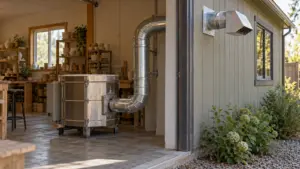
Where to Put a Kiln at Home Safely
Put your kiln in a dry, ventilated garage, detached studio, or purpose-built room, with 18 in of wall clearance as a practical target. Follow your model’s manual, since required clearances vary; keep the kiln away from combustibles, use a noncombustible floor, and provide the right electrical service and ventilation.
Where to put a kiln at home?
Quick answer: Put the kiln on a bare concrete or other noncombustible floor, in a covered, ventilated room with nothing flammable nearby. The maker recommends a sheltered, well-ventilated area such as a garage, but clearance changes by model, so use your own manual’s number, such as 18 in (46 cm) from walls for 2020 KilnMaster models.
- Combustibles: Keep 36 in from combustible surfaces.
- Power: Run a dedicated breaker sized 20% above the kiln’s maximum amperage draw.
- Vent: Use a downdraft vent such as the maker’s EnviroVent 2, or manual venting with adequate room ventilation.
- Cord: Place the receptacle where the 6 ft kiln cord reaches without strain.
How Much Clearance Does a Home Kiln Need?
Use the clearance in your kiln’s owner’s manual, because the number changes by model. For the KilnMaster models in a 2020 manual, keep the kiln at least 18 in (46 cm) from walls. A Paragon SC-series manual lists 12 in (30 cm) from the closest wall, but that copy is undated and hosted by a retailer, so confirm it against the manufacturer’s current document before you plan around it.
Measure from the kiln’s outside surface to each wall, ceiling, and shelf, then mark those distances on the floor before you move anything in. Check the General Dimension Drawing for your exact model instead.
Other items count toward your clearance too:
- Shelving: Keep shelves off the top of the kiln and allow proper clearance.
- Stored materials: Keep flammable materials where kiln heat cannot reach them.
- Multiple kilns: Position them so their control boxes don’t face each other.
Leave room for work, not just the kiln’s footprint. You need space to load the kiln, look it over, and reach it safely if something goes wrong. A layout that meets the numbers on paper still fails if you can’t get around the kiln.
Note
Local fire codes may also set sprinkler requirements for the room, so check them before you choose a spot.
Choose a Heat-Safe Floor and Room
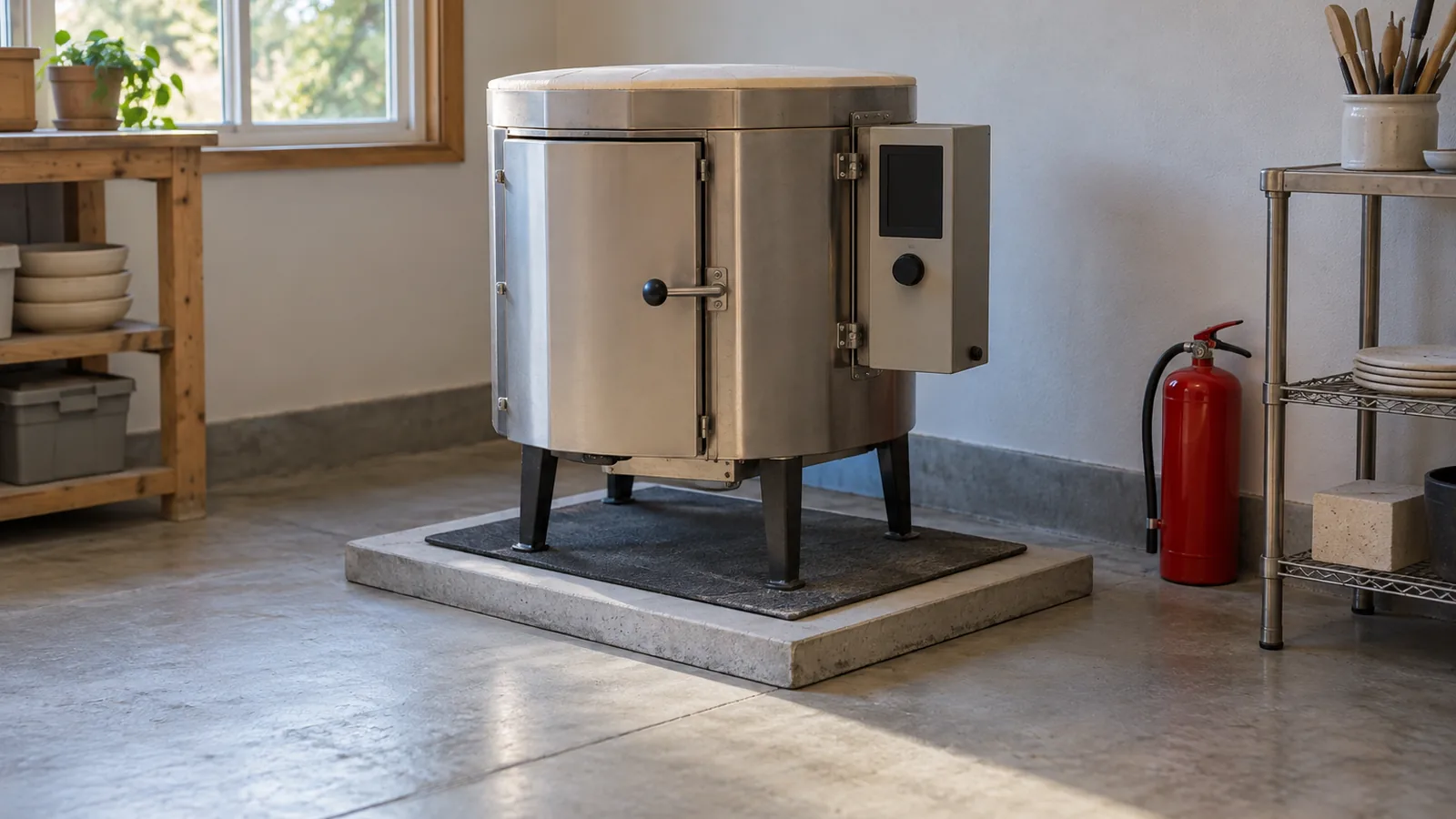
- Floor material: Skutt recommends bare concrete as the kiln floor. If concrete isn’t available, the Hot Kilns checklist calls for a non-combustible floor 2 in thick that extends 12 in (31 cm) past the kiln, with the factory-supplied kiln stand in place.
- Fire risk: Store no flammable materials where kiln heat can reach them, and keep the area around the kiln free of boxes, rags, and other clutter.
- Moisture: Pick a dry spot away from sinks, hose bibs, and leaks, since moisture can damage a kiln.
- Room type: Skutt recommends a sheltered, well-ventilated area such as a garage, and Hot Kilns says a garage is usually suitable if it is covered, ventilated, and meets the floor and clearance requirements.
- Structural support: Confirm the floor and stand can carry the kiln’s fully loaded weight before you set it in place.
Warning
Leaving a kiln outdoors exposes it to weather, moisture, windblown combustibles, and pests, which can damage it or raise the risk of fire.
A covered, ventilated garage with a concrete floor and no stored flammables meets most of these points. Before you buy, check the General Dimension Drawing for your specific model to confirm its footprint.
How Do You Plan Ventilation and Power?
Decide two things before installation: a vent that moves firing fumes outdoors, and an electrical supply that matches the kiln’s voltage, amperage, and phase. Use the values in your model’s manual, and hire a licensed electrician for the wiring.
Match the power specs to your building. Compare the kiln’s voltage, amperage, and phase with your building supply before you choose a circuit. Use the figures for your exact model, not a similar one.
Run a dedicated breaker for the kiln. The maker advises a dedicated breaker, so the kiln doesn’t share its circuit with other loads.
Keep the kiln within 50 ft of the breaker box. Measure the wire run from the panel. If the run has to be longer, use a heavier wire gauge.
Check the cord and receptacle. The kiln cord is 6 ft long, so place the receptacle where the cord reaches without strain and never touches the hot kiln. Don’t plug the kiln into an extension cord.
Choose your venting method. The maker recommends its EnviroVent 2 downdraft vent to exhaust potentially harmful fumes. Other setups need a different approach:
- Downdraft vent: Use the EnviroVent 2 for the maker’s kilns, which needs a 110–120 V outlet.
- Manual venting: Use this only with adequate room ventilation.
Install the vent outlet within 6 ft of the kiln. The maker’s documents list 6 ft in one place and 8 ft in another. Plan for 6 ft, the stricter figure, and confirm it against your model’s manual.
Add an exhaust fan or HVAC system and a thermometer. The checklist calls for both, so you can watch for excess heat in the room.
Check every item before the first firing. Run through the installation checklist and confirm the breaker, cord, vent, and thermometer all work.
Important
Size the breaker 20% above the kiln’s maximum amperage draw.
Home Kiln Location Quick Reference
Plan for 18 in of wall clearance, and confirm the figure in your model’s manual. Pair that with a dry, covered space and a dedicated breaker.
| Item | Recommended value | Range in sources | Verify before choosing a space |
|---|---|---|---|
| Wall clearance (in) | 18 | 9 to 18 | Measure from the kiln’s outer edge; 9 in applies only to kilns without circuit boards |
| Combustible clearance (in) | 36 | — | Wood shelving, cabinets, and stored materials must sit this far away |
| Floor base | Bare concrete, or 2 in noncombustible base extending 12 in past the kiln | 2 in masonry to 2 in noncombustible with stand | Reject carpet and combustible flooring; keep the factory stand |
| Ventilation | Downdraft vent, or manual venting with room ventilation plus exhaust fan or HVAC | — | Confirm a thermometer can track excess heat |
| Electrical circuit | Dedicated breaker sized 20% above maximum amperage draw | — | Check the kiln’s maximum amperage before buying the breaker |
| Vent outlet distance (ft) | 6 | 6 to 8 | Within 6 ft also meets the 8 ft installation limit |
| Moisture and weather | Dry, covered, enclosed space | — | Keep away from water, weather, windblown combustibles, and pests |
Use 18 in as your wall target, because the 9 in figure only applies to kilns without circuit boards.
Frequently Asked Questions
Can I put a pottery kiln in my basement safely?
A basement can work only if it meets the kiln’s installation requirements: a dry, ventilated space, required clearances, a noncombustible floor, and the correct electrical service. Check the model’s manual for its room-temperature limits.
Is it safe to leave a kiln running overnight?
No, do not leave a firing kiln unattended overnight; arrange awake, trained operator coverage. Monitor the room temperature during firing; the specified limit varies by kiln model.
What fire extinguisher works best for a kiln fire?
Use an extinguisher rated for the specific fire involved, and keep it accessible without placing it inside the kiln’s required clearance area. Ask your fire department which extinguisher rating fits your studio’s likely hazards.
Should I install a smoke detector near my kiln?
The installation guidance also calls for a thermometer to monitor room heat and says to check local fire codes for room requirements.
Can I use a kiln in an apartment?
Yes, if your apartment can meet the kiln’s clearance, floor, ventilation, and electrical requirements, and your building allows the installation. A garage or other covered, ventilated space is usually more suitable; don’t install the kiln outdoors or where moisture can reach it.
Conclusion
If you have a covered, ventilated garage with a bare concrete floor and room to keep stored materials away from the kiln, pick that space. If your only option is a living area or basement, look for another spot first, because those rooms make the clearance, ventilation, and fire rules harder to meet. Before you buy anything, measure the clearances from your model’s manual, mark them on the floor, and then have a licensed electrician confirm the circuit.
Sources
- skutt.com
- hotkilns.com
- clay-king.com
- Can you leave a kiln unattended overnight? (prokilnsupply.com, 2026-10-14T16:29:34-0600)