Glass Kiln vs Pottery Kiln: Which Should You Choose?
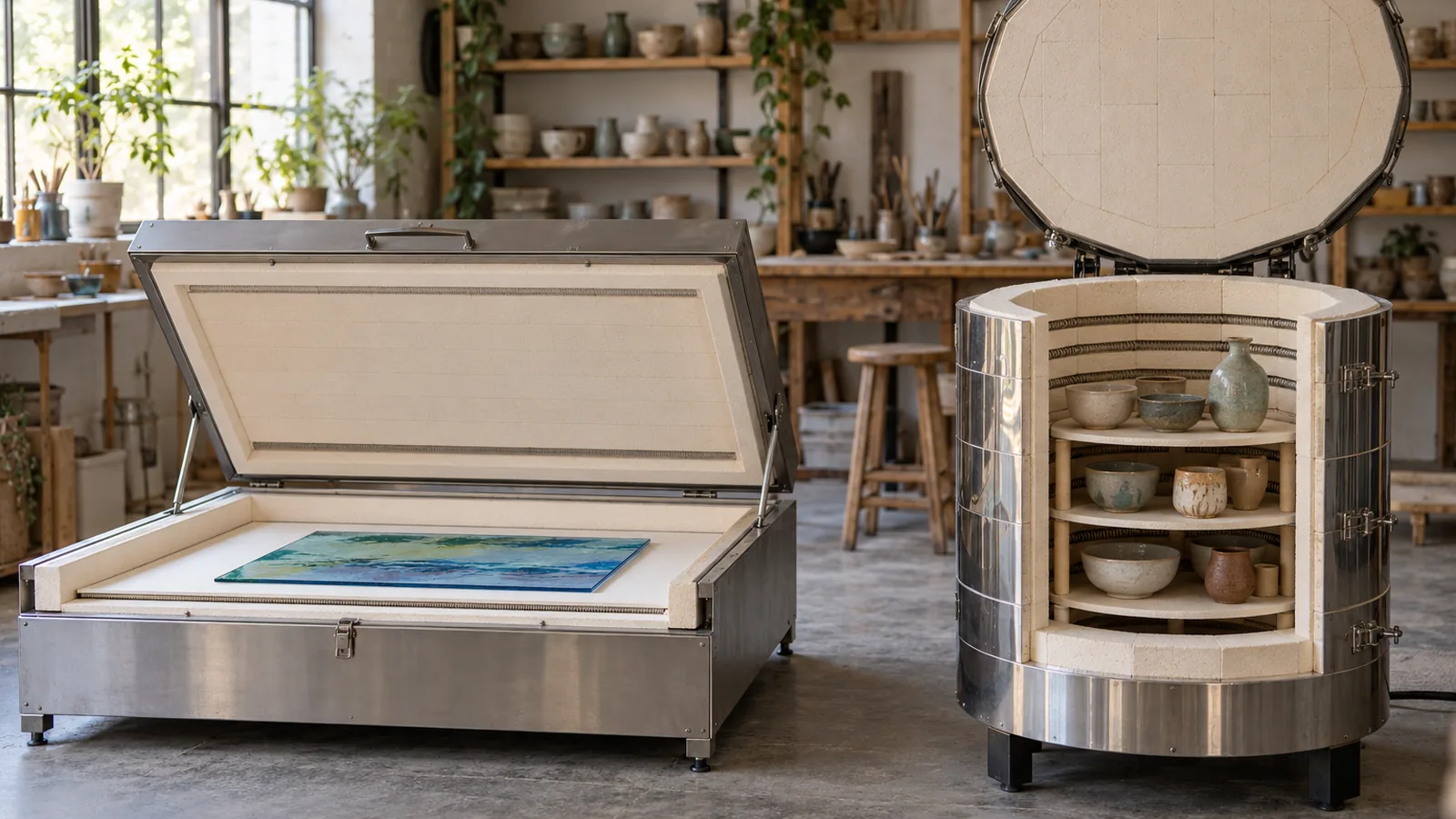
Choose a glass kiln for flat work: lid elements provide 70% of the heat in most glass kilns, while pottery kilns heat from the sides and accommodate stacked shelves. A glass kiln suits work on one shelf, while a pottery kiln suits taller ware and multiple levels.
A pottery kiln can fire glass if its controller supports a suitable schedule and you can heat and cool slowly; side-fired heat may warm shelf edges faster than the center. Avoid assuming a kiln’s ability to reach glass-fusing temperatures means it can control the firing well.
Key Takeaways
- Lid-fired heat suits flat glass on one shelf; side-fired pottery kilns fit taller ware and stacked shelves.
- Side-fired heat can vary across glass, warming shelf edges faster than the center; slower heating and cooling help limit breakage.
- Below 1000°F is stress-sensitive for glass, so firing schedules control ramp rates, holds, and cooling through those ranges.
- A manual or KilnSitter-only kiln can’t run programmed schedules, making precise glass firing harder than with an automatic controller.
- The listed models cost $1,355 to $6,460, but they are not directly comparable by cost or capacity.
Quick Verdict: Choose by Workpiece
A glass kiln is usually the better fit for flat work such as fusing and slumping: its lid elements direct heat down toward a single shelf. A pottery kiln primarily heats from sidewall elements and is built for taller ware arranged on multiple shelf levels.
Choose by the shape and layout of the work you fire:
- Flat glass on one level: Choose a glass-fusing kiln. Its wider, shallower chamber and lid-fired heat suit flat pieces placed on one shelf.
- Tall ceramic ware or stacked shelves: Choose a pottery kiln. Its side-fired design accommodates taller pieces and work on multiple levels.
- Glass in a pottery kiln: It can be possible, but the side elements may heat glass at the shelf edges faster than at the center. You’ll need slower heating and cooling to limit overfiring and breakage from thermal shock.
The practical dividing line is the workpiece, not just the kiln’s label. If you mainly fire flat glass, a lid-fired kiln gives heat from above across the single shelf. If you need several shelf levels for ceramics, a pottery kiln’s layout is designed for that job.
A pottery kiln isn’t automatically unsuitable for glass, but its heating pattern calls for more care. Glass schedules control heating and cooling because glass can develop stress and break when it passes too quickly through temperature-sensitive ranges below 1000°F. For occasional glass projects, consider whether you can follow a slower, controlled schedule and whether the piece fits the kiln’s shelf layout.
Glass Kiln vs Pottery Kiln Compared
Glass kilns generally direct most of their heat from the lid and suit flat work; pottery kilns heat from the sides and suit taller ware on stacked shelves. That design difference matters more than a model name when you’re choosing a kiln for a particular project.
| Kiln type | Heat placement | Intended work | Chamber and shelves | Controller and firing control | Source |
|---|---|---|---|---|---|
| Glass kiln | Lid element supplies 70% of heat; side elements supply 30% | Flat glass work | Wider, shallower chamber; an upper shelf can block heat to work below | — | skutt.com |
| Pottery kiln | Sidewall elements provide the primary heat | Taller ceramic ware | Chamber accommodates taller ware and stacked shelves | — | hotkilns.com |
The chamber and element layout make the practical choice clear: a glass kiln gives flat work a direct path to heat, while a pottery kiln makes better use of height and multiple shelf levels. The upper shelf in a lid-fired kiln can shade work beneath it, limiting how well you can use the full chamber for stacked glass pieces.
Prices, capacities and controller specifications are not listed on a comparable basis for the FireBox 8×4, FireBox 8×6, GM814, GM1227-3, ceramic 818, or Janus listings. Those models can’t be ranked by cost or capacity from these details alone.
Can a Pottery Kiln Fire Glass Safely?
A pottery kiln can fire glass, but side-fired heat is uneven: glass near the shelf edges may heat faster than glass at the center. Use slower heating and cooling to reduce overfiring and thermal-shock breakage, which happens when glass changes temperature too quickly. The glass kiln vs pottery kiln choice matters most when you need consistent heat across a flat piece and controlled cooling.
Glass can develop stress in temperature-sensitive ranges below 1000°F, so a firing program controls ramp rates, holds, and cooling through those ranges. Most fusing glass reaches its fusing range between 1450°F and 1480°F; a 30-minute hold at 1450°F can provide similar heatwork to a 10-minute hold at 1480°F. The hold matters because time and temperature both affect how much the glass softens.
L&L gives this schedule as a starting point for Bullseye, Uroboros, or Spectrum glass, not for float or borosilicate glass:
- Ramp to 1450°F and hold for 15 minutes.
- Cool at 150°F per hour to 100°F, then hold for 30 minutes.
A manual or KilnSitter-only pottery kiln can’t run a programmed temperature-versus-time schedule. Skutt describes fusing with a KilnSitter instead of an automatic controller as difficult and not recommended. A programmable controller gives you control over the ramps, holds, and cooling needed for glass; confirm glass compatibility with the supplier, since factors such as coefficient of expansion and viscosity affect whether glass types can be fused together.
How Much Do Comparable Kilns Cost?
The notes list the FireBox 8×4 at $1,355 and the GM1227-3 at $6,460, and FireBox models appear on both price lists.
| Model | Price (USD) | Range in sources (USD) | Chamber dimensions (in.) | Capacity (cu. ft.) | Source |
|---|---|---|---|---|---|
| GM814 | $2,950 | — | 18 × 18 opening; 13.5 deep | 2.0 | skutt.com |
| Ceramic FireBox 8×4 | $1,410 | — | 8 × 8 × 4.5 | — | skutt.com |
| Ceramic FireBox 8×6 | $1,490 | — | 8 × 8 × 6.5 | — | skutt.com |
| Ceramic 818 | $2,940 | — | 17.5 × 18 | 19 | skutt.com |
| Paragon CT81713 Janus | $3,400 list; $3,060 sale | $2,790–$3,400 | 16.5 × 13.25 | 1.75 | paragonkilns.com |
The Janus price needs confirmation: its current page lists $3,400 list and $3,060 sale, while an older page lists $3,100 list and $2,790 sale. For a small budget comparison, the FireBox prices are close, but chamber dimensions and capacity differ by model. The larger listed models cost more, and the GM814 and Janus capacities provide useful context for comparing studio space needs.
What a Glass Firing Schedule Requires
Programmable ramps, holds, and controlled cooling
Glass firing needs a temperature-versus-time schedule because heating or cooling too quickly through temperature-sensitive ranges below 1000°F can leave stress in the glass and cause it to break. A programmable controller lets you set the ramp rate, hold time, and cooling rate for each stage.
The schedule depends on the glass and the result you want. For example, a sample program for some fusing glasses ramps to 1450°F, holds for 15 minutes, then cools at 150°F per hour to 100°F and holds for 30 minutes; it is not intended for float or borosilicate glass.
Annealing and reducing thermal shock
An annealing hold gives the glass time to cool in a controlled way. This matters because rapid cooling can create stress, especially as glass passes through temperature-sensitive ranges. Follow a schedule made for your glass type, and check compatibility with the supplier, since glass properties affect whether pieces can be fused together.
Controller and heating-element considerations
If you use a pottery kiln, slower heating and cooling can help limit the risk of overfiring and thermal-shock breakage.
Heating patterns also affect flat glass. Glass kilns generally direct most heat from elements in the lid onto one shelf, while pottery kilns primarily heat from the sides. Side-fired kilns can heat glass faster at the shelf edges than at the center, so the firing schedule needs to account for uneven heating. In a lid-fired kiln, an upper shelf can block radiant heat from reaching work below.
Frequently Asked Questions
Can a glass kiln fire pottery or ceramic clay?
No. Glass kilns are generally designed for flat work and heat from the lid, while pottery kilns accommodate taller ceramic ware on stacked shelves.
How do I protect a pottery kiln shelf when firing glass?
Apply kiln wash to the shelf so glass won’t fuse directly to it if it softens during firing; follow the kiln and glass suppliers’ instructions for the materials you use. Glass can soften between 1450°F and 1480°F, and side-fired pottery kilns may heat glass at the shelf edges faster than at the center.
Can one kiln be used for both pottery and glass?
Yes, a pottery kiln can fire glass if it can run a controlled schedule and you adjust for its side-fired heat pattern. A manual or KilnSitter-only kiln can’t program ramps and holds, so an automatic controller is the practical choice for managing glass heating and cooling.
What temperature does a glass kiln need for fusing or slumping?
Ramp rates, hold times, and cooling control how the glass softens and reduce stress from temperature changes. Slumping uses a different GlassFire setting from fusing.
What should I check before trying glass in my pottery kiln?
Check that the controller can run a programmed schedule, the piece fits the shelf layout, and you can use slower heating and cooling to limit uneven heating and thermal shock.
Conclusion
If you mainly fire flat glass, choose a glass kiln; if you need height and stacked shelves for ceramics, choose a pottery kiln. A pottery kiln can work for occasional glass projects when it has a programmable controller and you can use a schedule suited to the glass.
Before you buy, sketch the size and shelf layout of your typical work, then compare it with each kiln’s chamber and controller details. If you’re considering a pottery kiln for glass, confirm compatibility and firing schedules with the supplier.
Sources
- skutt.com (skutt.com)
- Firing Glass Instructions in a Ceramic Kiln (hotkilns.com)
- GM-814 – Kilns | Ceramic Pottery Kiln, Glass Kiln, Pottery Wheels | Skutt (skutt.com)
- The Basics – Kilns | Ceramic Pottery Kiln, Glass Kiln, Pottery Wheels | Skutt (skutt.com)
- skutt.com (skutt.com)
- GM-818 – Kilns | Ceramic Pottery Kiln, Glass Kiln, Pottery Wheels | Skutt (skutt.com)
- Glass 101 – Kilns | Ceramic Pottery Kiln, Glass Kiln, Pottery Wheels | Skutt (skutt.com)
- skutt.com (skutt.com)
- skutt.com (skutt.com)
- paragonkilns.com (paragonkilns.com)