Porcelain vs Ceramic Pottery: What’s the Difference?
Porcelain is a type of ceramic pottery, so “porcelain vs ceramic” isn’t a comparison between separate categories. In pottery, “ceramic” often means stoneware or earthenware instead. Porcelain is commonly made with kaolin, feldspar, and silica, and it’s often white and low in porosity when well fired. It can also be harder to shape and dry than other clay bodies.
The comparison changes depending on what “ceramic” means and what you need from the finished piece. Avoid assuming the category name alone tells you a pot’s porosity or performance; clay composition and firing affect both.
Key Takeaways
- Porcelain is a type of ceramic pottery, while “ceramic” in comparisons often means stoneware or earthenware.
- Porcelain commonly contains kaolin, feldspar, and silica; other ceramic bodies use a broader range of clay blends.
- More vitrification means less porosity, but the result depends on the clay body and firing conditions.
- Porcelain needs careful handling because it responds quickly to pressure and can be harder to form.
- Test clay and glaze together in your kiln because glaze response varies by body and firing.
Quick Verdict: Porcelain Is Ceramic
Porcelain is ceramic pottery. “Ceramic” is the broad category; porcelain is one kind of ceramic body.
| Term | Meaning in pottery |
|---|---|
| Ceramic | Broad category that includes porcelain, stoneware, and earthenware |
| Porcelain | A specific type of ceramic pottery |
| “Ceramic,” contrasted with porcelain | Often shorthand for stoneware or earthenware |
That distinction helps you read product descriptions and pottery advice more accurately. If a source compares porcelain with “ceramic,” check whether it means ceramic pottery in general or a particular body such as stoneware or earthenware.
Porcelain vs Ceramic Pottery at a Glance
The differences are mainly in the clay body and how it behaves after firing.
| Feature | Porcelain | Stoneware or earthenware |
|---|---|---|
| Category | A type of ceramic pottery | Other types of ceramic pottery |
| Typical composition | Kaolin, feldspar, and silica | A broader range of clay bodies, including iron-bearing clays |
| Firing and vitrification | Typically fired to a highly vitrified body | Firing and vitrification vary by clay body |
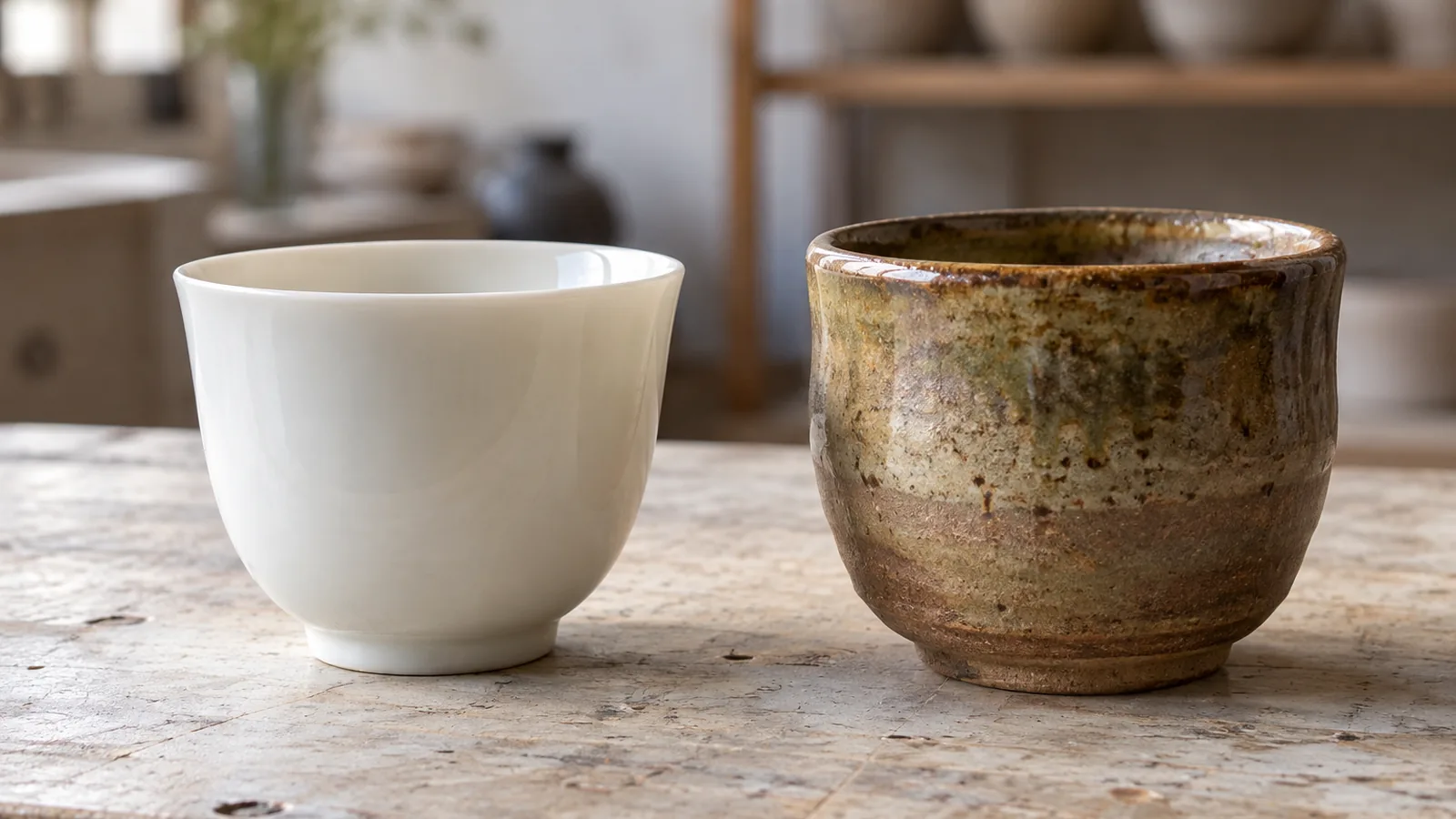
| Fired appearance | Often white and, when thin, translucent | Color varies with the body and firing |
| Porosity | Generally low when well fired | Varies with clay body and firing |
| Workability | Often less forgiving to shape and dry | Varies, with some bodies easier to work |
The comparison depends on what “ceramic” means: porcelain belongs to the ceramic category, so the useful contrast is porcelain against other clay bodies. A broad label like “ceramic” can’t predict a piece’s porosity or workability on its own, because those traits vary by body and firing. For a specific piece, its clay body and firing matter more than the category name.
How Composition and Firing Change the Result
Porcelain’s recipe helps explain why it can look different from other ceramic pottery. It commonly combines kaolin, feldspar, and silica, while ceramic bodies as a broader group can use many clay blends, including iron-bearing clays. The ingredients affect how a body behaves as it dries and fires, but no single recipe defines all ceramic pottery.
Firing changes the clay body through vitrification, the process in which heat makes its particles fuse into a denser, less porous material. More vitrification means less porosity; how far a body vitrifies depends on its composition and firing conditions. Porcelain is fired at a higher temperature than earthenware, but the available comparisons don’t establish a specific firing range for every porcelain or ceramic body.
The fired result can differ in color and light transmission. Porcelain is commonly white and may be translucent when thin, while iron-bearing clay bodies can fire to darker colors. These are tendencies, not guarantees: a body’s ingredients and firing affect its final appearance.
Porosity also matters in use. A more vitrified body absorbs less water, while a less vitrified body remains more porous. That difference can affect how a finished piece performs, but the category name alone doesn’t tell you its exact porosity. Check the clay body’s firing guidance and intended use when you need a specific result, since composition and firing work together to determine the fired piece’s properties.
How Each Clay Handles Making and Use
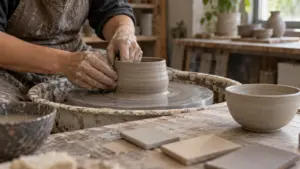
Porcelain can feel demanding on the wheel: its fine, smooth body responds quickly to pressure, so you need steady control. Stoneware and earthenware are generally more forgiving to throw and handbuild, making them easier to shape when you’re learning or working with larger forms.
Drying and firing can also expose differences. Porcelain shrinks more than many other clay bodies, which raises the risk of cracking if drying is uneven or the piece is poorly supported. Thin porcelain forms may slump during firing, so you need to manage shape and thickness carefully. Stoneware and earthenware can also crack or warp, but their workability is often easier to control.
For finished pieces, porcelain’s dense, vitrified body absorbs less water than more porous earthenware. That low absorption can suit functional ware, though food safety also depends on the glaze and firing. Porcelain can be strong, but thin edges and exposed rims may chip; strength doesn’t make it immune to damage.
Glaze response varies by body and firing. Porcelain’s light surface can show glaze color clearly, while its smooth body may make some glazes run or fit poorly. Stoneware and earthenware offer different surfaces and glaze results, so test the clay and glaze together under your kiln’s firing conditions before making a full batch.
Which Clay Body Should You Choose?
Functional pottery buyer: Choose a well-vitrified porcelain body if you want finished ware with low porosity. Porcelain’s fine, pale appearance can suit tableware, but the body and glaze still need to fit your kiln’s firing capability. Low porosity is a useful trait for functional pieces, though food safety depends on the specific clay and glaze.
Studio potter: Pick the body that fits your forming skills and the work you plan to make. Porcelain can be more challenging to work with, while stoneware and earthenware offer alternatives within the broader ceramic category. Workability matters if you’re building by hand or throwing, since a difficult body can make forming less predictable.
Glaze- and finish-focused maker: Choose porcelain when a light fired color or translucency suits your design. Its composition and firing affect those results, while other ceramic bodies can produce different fired colors and finishes. Match glaze and clay to your kiln so the body can reach its intended fired state.
Cost-conscious hobbyist: Compare locally available clay bodies and choose one that fits your kiln and forming plans. Prices vary by brand and supplier, so compare current prices. Start with a forgiving body if you’re still building your skills; porcelain’s workability can pose a greater challenge than other ceramic bodies.
Frequently Asked Questions
How does porcelain compare with stoneware for throwing on the wheel?
Porcelain usually takes more control to throw than stoneware because its fine, smooth body responds quickly to pressure. Stoneware is generally more forgiving to shape, while porcelain’s faster response can make it harder to keep a form even.
Why do glazes look different on porcelain and stoneware?
Glazes can look different because the clay body’s color and surface affect the fired result. Porcelain’s light surface can show glaze color clearly, while its smooth body may cause some glazes to run or fit poorly; test the clay and glaze together at your firing conditions.
Does porcelain need glaze to hold water?
No, well-fired porcelain is generally low in porosity, so it absorbs less water than more porous earthenware. Low porosity depends on firing, however, and the category name alone doesn’t establish a specific piece’s water absorption; glaze and firing also matter for functional use.
Can porcelain pottery go in the microwave or dishwasher?
The label “porcelain” alone can’t tell you if a piece is suitable for microwave or dishwasher use. Its performance depends on the body, firing, and glaze, and those details aren’t established by the category name; check the maker’s care guidance for the specific piece.
How can I tell whether a piece is porcelain or stoneware?
Look for clues in color and translucency: porcelain is often white and may transmit light when thin, while stoneware color varies with its body and firing. These traits aren’t guarantees, so appearance alone can’t confirm the body; use the maker’s description when you need certainty.
Conclusion
If you want low porosity or a pale, potentially translucent finish, choose porcelain, provided your forming skills and kiln suit the body. If you want a more forgiving clay to shape, start with stoneware or earthenware. Before buying, check the clay body’s firing guidance and intended use, then test a small piece with your glaze under your kiln’s conditions. That gives you a practical read on how the clay handles and what the finished result will be.
Sources
- artabys.com (artabys.com)
- ceramicguide.com (ceramicguide.com)
- boulderpotterystudio.com (boulderpotterystudio.com)
- homepotteryhq.com (homepotteryhq.com)
- jingform.com (jingform.com)