Do You Need a Slab Roller for Pottery?
The answer to “do you need a slab roller for pottery” is no: 0 rollers are required if you roll slabs by hand with a rolling pin and thickness guides. Consider a roller if you often make broad sheets or batches of similar pieces, where more even, repeatable slabs can save effort.
Quick answer
Do you need a slab roller for pottery?
No. You can make slabs with a rolling pin and two equal-thickness guides, rolling until the pin rests on both guides. Choose guides to match your project: one plate-making example uses ¼-inch guides. Consider a slab roller if you regularly make large slabs or batches that need repeatable thickness, since it reduces hand-rolling effort.
- For occasional or small projects, use a rolling pin and thickness guides.
- For larger, frequent, or repeated slab work, consider a slab roller.
- Without a rolling pin, press or beat the clay flat by hand; the cited method doesn’t specify precise thickness control.
When does a slab roller make a difference?
A slab roller becomes more useful as your slabs get larger, your need for consistent thickness grows, or you make slabs more often. Frequency, size, and repeatability matter more than any fixed number of studio sessions.
| Example project | Slab thickness (inches) | Source |
|---|---|---|
| Mug or small tile | ⅜ | theclayhole.com |
| Dinner plate | ¼ | ceramicartsnetwork.org |
| Several plates | ½ | ceramicartsnetwork.org |
These examples show that slab thickness depends on the project, so a roller’s value isn’t simply about making every slab the same thickness. The advantage is control and repeatability when you need broad, even sheets or several similar slabs; a roller also reduces the physical effort of rolling by hand.
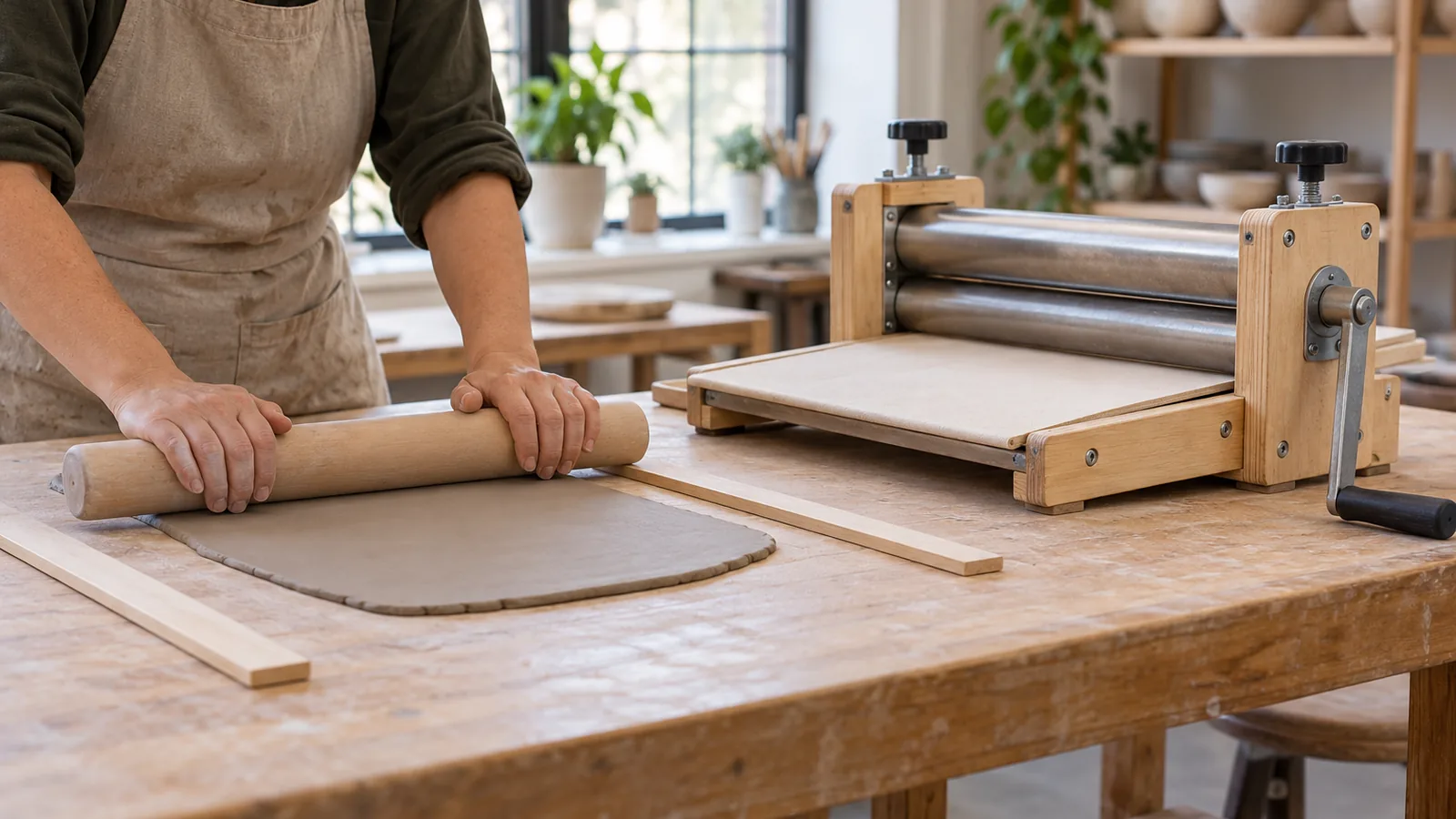
For occasional or small slab work, a rolling pin with equal-thickness guides can be a practical approach. Place one guide on each side of the clay, then roll until both ends of the pin rest on the guides. Rotate the clay between passes; flipping and turning it 90° before each roll can help minimize curling.
Choose equipment around the work you actually repeat: a roller is more useful for frequent slab-making, large slabs, or batches of similar pieces. It prepares clay sheets, but you still need to compress, cut, shape, join, and dry the clay to finish a pot.
Which projects benefit from a slab roller?
A slab roller is most useful for work that needs broad, even sheets of clay, such as plates, platters, and flat panels for assembled forms. It can also help when you’re making several similar pieces, since it produces slabs with more repeatable thickness.
For plates and platters, a consistent slab gives you a more even sheet to cut and shape. For boxes and other template-built forms, you can roll a sheet, cut flat panels, then assemble them. A slab roller prepares the clay, though you still need to compress, cut, shape, join, and dry the pieces.
The benefit is clearest when your projects call for large or repeatable slabs. If you’re making a single small piece now and then, a rolling pin and thickness guides can be practical instead. The slab roller becomes more useful for frequent work, larger sheets, or batches of similar pieces.
Choose based on the work you actually make: broad sheets and repeated forms favor a slab roller, while occasional projects may not justify dedicated equipment.
How often do you need to make slabs?
Make slabs occasionally, and a rolling pin with thickness guides is usually enough; make them repeatedly, and a slab roller becomes more useful.
For occasional slab work or small projects, hand-rolling avoids dedicating studio space to a roller. You can use the same approach when you need a consistent thickness for a one-off project.
A slab roller earns its place when slabs are a regular part of your studio work. It passes clay through rollers to produce broad, relatively even sheets, with less physical effort than hand-rolling and better repeatability. That consistency can be useful when you make batches of similar pieces or regularly need large slabs.
The decision isn’t simply about owning a tool or making do without one. Consider whether hand-rolling meets your needs for slab size and repeatable thickness, and how often you repeat the process. If you make slabs only now and then, start with guides and a rolling pin; if you rely on slabs for ongoing production, a roller may be worth considering.
Alternatives for making pottery slabs
You can make pottery slabs with a rolling pin and thickness guides; a slab roller isn’t required. This gives you a way to control thickness without dedicated equipment, so if you’re asking “do you need a slab roller for pottery,” hand-rolling is a practical alternative for some projects.
Choose guides that match the thickness your project calls for, since the right thickness depends on the piece. A plate-making project uses two ¼-inch (6 mm) wood planks as guides, while another guide gives ⅜ inch (about 9.5 mm) as an example for a mug or small tile. Those are examples, not universal settings: follow the needs of your own form.
Rotate the clay between passes to help minimize curling. One cited method flips and turns the slab 90° before each roll. Keep the guides parallel and roll across the clay until the pin rests on both sides, then rotate the clay before the next pass.
If you don’t have a rolling pin, you can press or beat the clay by hand into a flat shape. That method is an option for forming a slab, but the cited guide doesn’t give a precise way to control its thickness. For slabs that need more consistent thickness, use a rolling pin with guides; if you make slabs often or work with larger pieces, a slab roller may be more useful.
Frequently Asked Questions
Is a slab roller worth the investment for a home pottery studio?
Yes, if you regularly make large slabs or batches of pieces that need consistent thickness; for occasional or small projects, a rolling pin and guides can work well. Frequency, slab size, and repeatability are better decision points than a fixed number of studio sessions.
How much space does a pottery slab roller need?
The space required depends on the roller, so choose one only after checking its dimensions against your available work area. If space is limited and you make slabs occasionally, a rolling pin and thickness guides avoid dedicating room to a roller.
How do you use a slab roller safely?
Roll clay through the rollers in stages, adjusting the clay as needed to form an even sheet. Keep your hands clear of the rollers while feeding clay through, and follow the machine’s instructions, since safe operation depends on the specific roller.
Can a slab roller handle different clay thicknesses?
Yes, a slab roller can produce slabs for different projects, but the appropriate thickness depends on what you’re making.
Are tabletop slab rollers good for beginners?
Yes, a tabletop roller can suit a beginner who regularly needs broad, repeatable slabs, but occasional or small projects may not justify buying one. A rolling pin with equal-thickness guides is a practical way to start, and you can assess whether hand-rolling meets your needs.
Conclusion
If you make slabs now and then, start with a rolling pin and equal-thickness guides; if you regularly make broad sheets or batches of similar pieces, consider a slab roller. Try the hand-rolling method on your next project and see whether it gives you the size and consistency you need. Move to a roller only if that process keeps falling short for the work you repeat.
Sources
- Pottery Slab Roller: How to Choose One for Your Studio (thekilndepot.com, 2026-09-15T21:15:41+00:00)
- ceramicartsnetwork.org (ceramicartsnetwork.org)
- theclayhole.com (theclayhole.com)
- ceramicartsnetwork.org (ceramicartsnetwork.org)
- ceramicartsnetwork.org (ceramicartsnetwork.org)
- ceramicartsnetwork.org (ceramicartsnetwork.org)
- ceramicartsnetwork.org (ceramicartsnetwork.org)