Types of Pottery Wheels and How They Differ
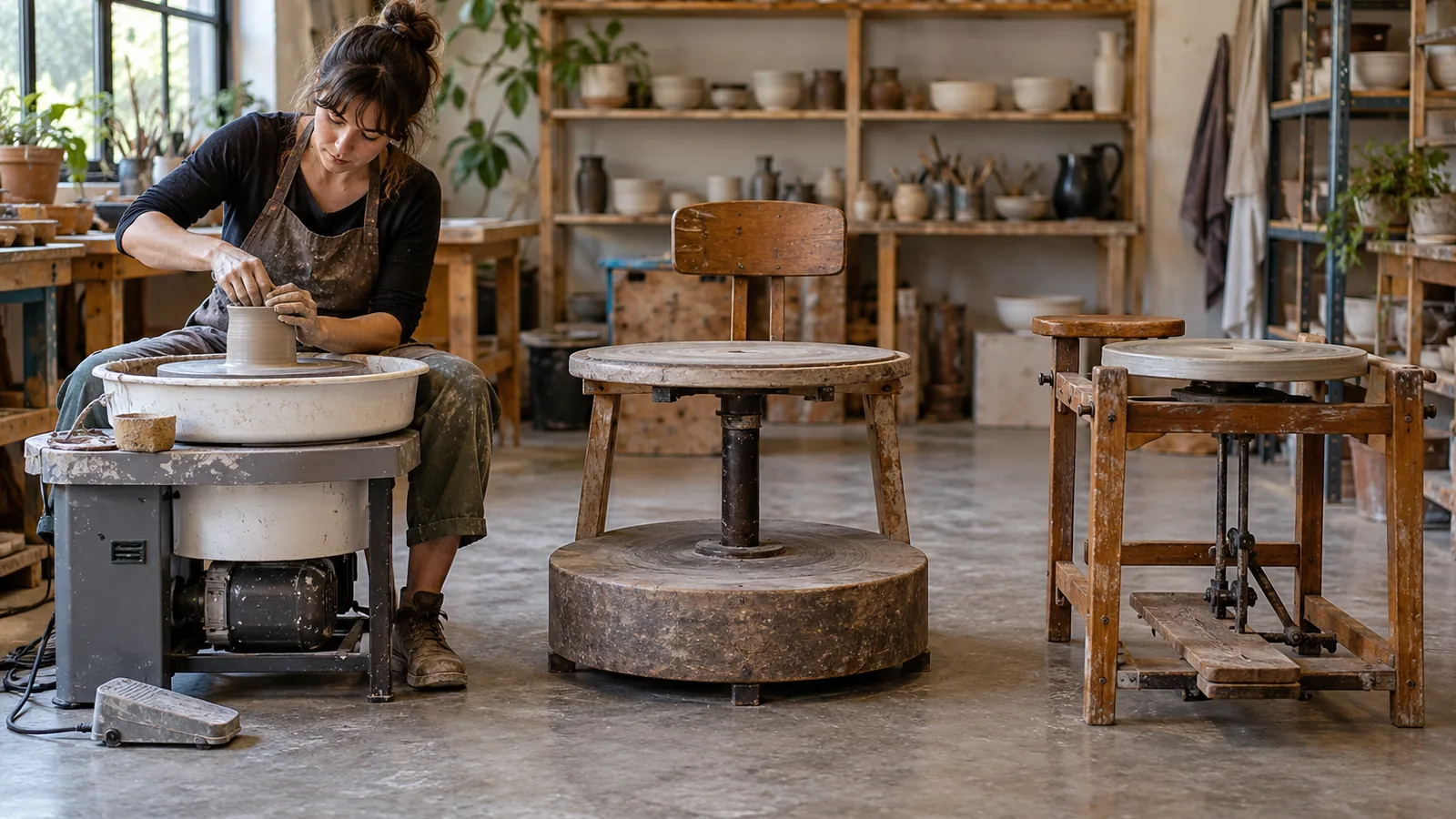
Pottery wheels fall into 3 main types by power source: electric wheels use a motor, while kick and treadle wheels rely on your physical effort. Some hybrid wheels combine kicking with motor power. Choose based on your workspace, preferred feel, and intended work, and don’t confuse a banding wheel, which you turn by hand, with a throwing wheel.
What are the types of pottery wheels?
Quick answer: Pottery throwing wheels are commonly grouped by how they’re powered: electric wheels use a motor, while kick and treadle wheels use your physical effort. A hybrid kick wheel can run by kicking or by motor, and a banding wheel is a hand-turned turntable for decorating and handbuilding, not motor-driven throwing. Choose an electric wheel if you want motor-driven rotation; choose a kick or treadle wheel if you want to power the wheel yourself, and check the specific model’s dimensions and power needs against your workspace.
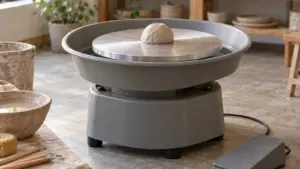
- Electric throwing wheel: A motor turns the wheelhead; a foot pedal commonly controls speed.
- Kick wheel: You kick a heavy flywheel, whose momentum turns the wheelhead.
- Treadle wheel: You repeatedly press a pedal linked to a flywheel.
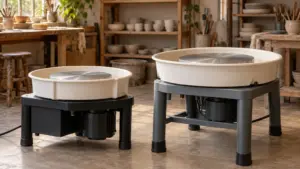
- Hybrid kick wheel: You can power it by kicking or with a motor.
- Manual banding wheel: Turn the work by hand for decorating, sculpting, carving, or handbuilding.
How do pottery wheel types differ?
The drive mechanism is the useful way to distinguish throwing-wheel types.
On a kick wheel, you kick a heavy flywheel, whose momentum keeps the wheelhead turning; kicking faster increases the wheelhead’s speed. On a treadle wheel, you repeatedly press a foot pedal linked to a flywheel, and your pedal rhythm sustains and influences the rotation. An electric wheel’s motor turns the wheelhead, and a foot pedal commonly controls its speed.
Some kick wheels combine both methods: one documented design can run by kicking alone or with a motor. So the labels describe the power source and operation, but a hybrid may offer more than one way to turn the wheelhead.
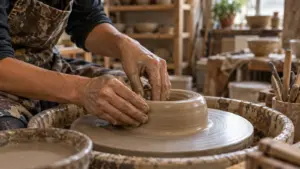
Keep banding wheels separate from throwing wheels when comparing types. A banding wheel is a manually turned turntable that lets you reach different sides of work while decorating, sculpting, carving, or handbuilding. You can shape clay on one by hand, but that is different from using a powered wheelhead for throwing.
What should you know about electric wheels?
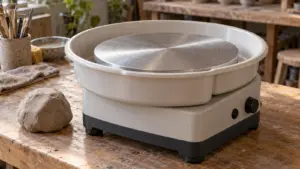
An electric pottery wheel uses a motor to rotate its wheelhead, and a foot pedal commonly changes the wheel’s speed. Among the types of pottery wheels, electric models stand out because they rely on electrical power rather than the potter’s effort to turn the wheelhead.
When comparing electric models, check these features in the specifications:
- Speed range: Listed ranges vary by model. A Brent 2020 catalog gives 0–240 rpm, while a 2025 VEVOR product sheet gives 50–300 rpm. Compare the range for the specific wheel you’re considering rather than treating either figure as standard.
- Speed and direction controls: Some electric wheels offer electronic speed control and reversible rotation. Check whether a model has those options if you want to adjust speed electronically or change the wheelhead’s direction.
- Power requirements: Skutt’s 2017 specifications list its U.S. and Canada electric wheel models at 110–120 V, with motors from ⅓ to 1 hp and current from 4.2 to 12.8 A. Use the specifications for your chosen model to check compatibility with your workspace’s power supply.
- Portability: Some electric wheels are small and portable, but that depends on the model. Check the individual wheel’s size and portability details before planning where to use it.
Choose a model based on its controls, power needs, and fit for your workspace.
How do kick wheels and treadle wheels work?
Kick wheels run when you kick a heavy flywheel, while treadle wheels run when you repeatedly press a foot pedal linked to a flywheel.
The main difference is how you keep the flywheel moving: you kick it directly on a kick wheel, or press a pedal on a treadle wheel. One documented treadle design uses a back-and-forth pedal motion. Some kick wheels also have a motor, so you can power the documented hybrid design by kicking or using its motor.
Setup and space needs vary by design, so check the dimensions of the specific wheel you’re considering. For reference, one treadle-wheel advertisement lists a footprint of 30 in wide by 24 in deep and a weight of 140 lb. A standing kick wheel is listed at approximately 675 × 620 × 950 mm, while a documented hybrid measures 120 cm wide by 110 cm long. Those examples show why you shouldn’t assume all human-powered wheels need the same space or are easy to move.
A documented kick wheel uses a concrete flywheel that measures 60 cm across and weighs 35 kg; this is specific to that design. When comparing types of pottery wheels, consider whether you want to supply power by kicking or pedaling, and measure your workspace against the particular model’s listed dimensions.
Compare pottery wheel types at a glance
Electric wheels use a motor, while kick and treadle wheels rely on the potter’s effort; a manual banding wheel is for turning work during handbuilding and decorating, not motor-driven throwing. The practical difference is how you supply rotation and whether the wheel is built for throwing or for turning a piece by hand.
| Type | Power source | How the wheelhead or turntable turns | Practical consideration |
|---|---|---|---|
| Electric throwing wheel | Motor | The motor rotates the wheelhead; a foot pedal commonly varies speed | Requires electrical power |
| Kick wheel | Potter’s effort | The potter kicks a heavy flywheel; its momentum drives the wheelhead | Kicking faster increases wheelhead speed |
| Hybrid kick wheel | Potter’s effort, motor, or both | The potter kicks the flywheel, or a motor turns it | Documented versions include kick-only and kick-with-motor designs |
| Treadle wheel | Potter’s effort | A back-and-forth treadle drives the wheel | A historical advertisement lists a 140 lb wheel measuring 30 in wide × 24 in deep × 34 in tall |
| Manual banding wheel | Hand turning | The user turns a manual turntable | Used to access different sides of work during decorating, sculpting, carving, and handbuilding |
Human-powered throwing wheels differ in how you supply motion: kicking drives a flywheel, while the documented treadle uses a back-and-forth pedal. A hybrid offers a motor option alongside kicking.
Frequently Asked Questions
Is a pottery wheel the same as a banding wheel?
No. A pottery throwing wheel turns a wheelhead for shaping clay, while a banding wheel is a hand-turned turntable that helps you reach different sides of work during decorating, carving, sculpting, or handbuilding.
Can beginners use a kick wheel?
Yes. A kick wheel turns when you kick its heavy flywheel, and kicking faster increases the wheelhead’s speed. Choose one if you’re comfortable supplying that motion rather than using a motor and foot pedal.
Does an electric pottery wheel need a special power supply?
No, not necessarily. Check the exact model’s electrical requirements against your workspace before buying, since voltage and current vary across electric wheels. Skutt’s U.S. and Canada models are specified at 110–120 V, with listed current from 4.2 to 12.8 A.
Can a pottery wheel be used outdoors?
Yes, if the wheel’s setup and power needs suit the location. Check the model’s requirements and the available supply before using one outdoors. Kick and treadle wheels rely on your physical effort instead, though their dimensions still affect where you can set them up.
What is the difference between a kick wheel and a treadle wheel?
A kick wheel uses your foot to kick a heavy flywheel, while a treadle wheel uses repeated pedal presses to keep its flywheel turning.
Conclusion
If you want throwing with motor-driven rotation, choose an electric wheel; if you prefer to power the wheel yourself, compare kick and treadle designs. Pick a banding wheel only if you need a hand-turned surface for decorating or handbuilding, rather than a throwing wheel. Before choosing, measure your workspace and check the specific wheel’s dimensions, power needs, and controls. That gives you a practical shortlist based on how you’ll work and where the wheel will go.
Sources
- Realization – Pottery wheel | Kizek.cz (kizek.cz)
- troop-63.org (troop-63.org)
- ceramicartsnetwork.org (ceramicartsnetwork.org)
- ceramicartsnetwork.org (ceramicartsnetwork.org)
- skutt.com (skutt.com)
- ceramicartsnetwork.org (ceramicartsnetwork.org)
- cromartiehobbycraft.co.uk (cromartiehobbycraft.co.uk)
- runyanpotterysupply.com (runyanpotterysupply.com)
- images.thdstatic.com (images.thdstatic.com)