Difference Between Ceramic and Clay in Pottery
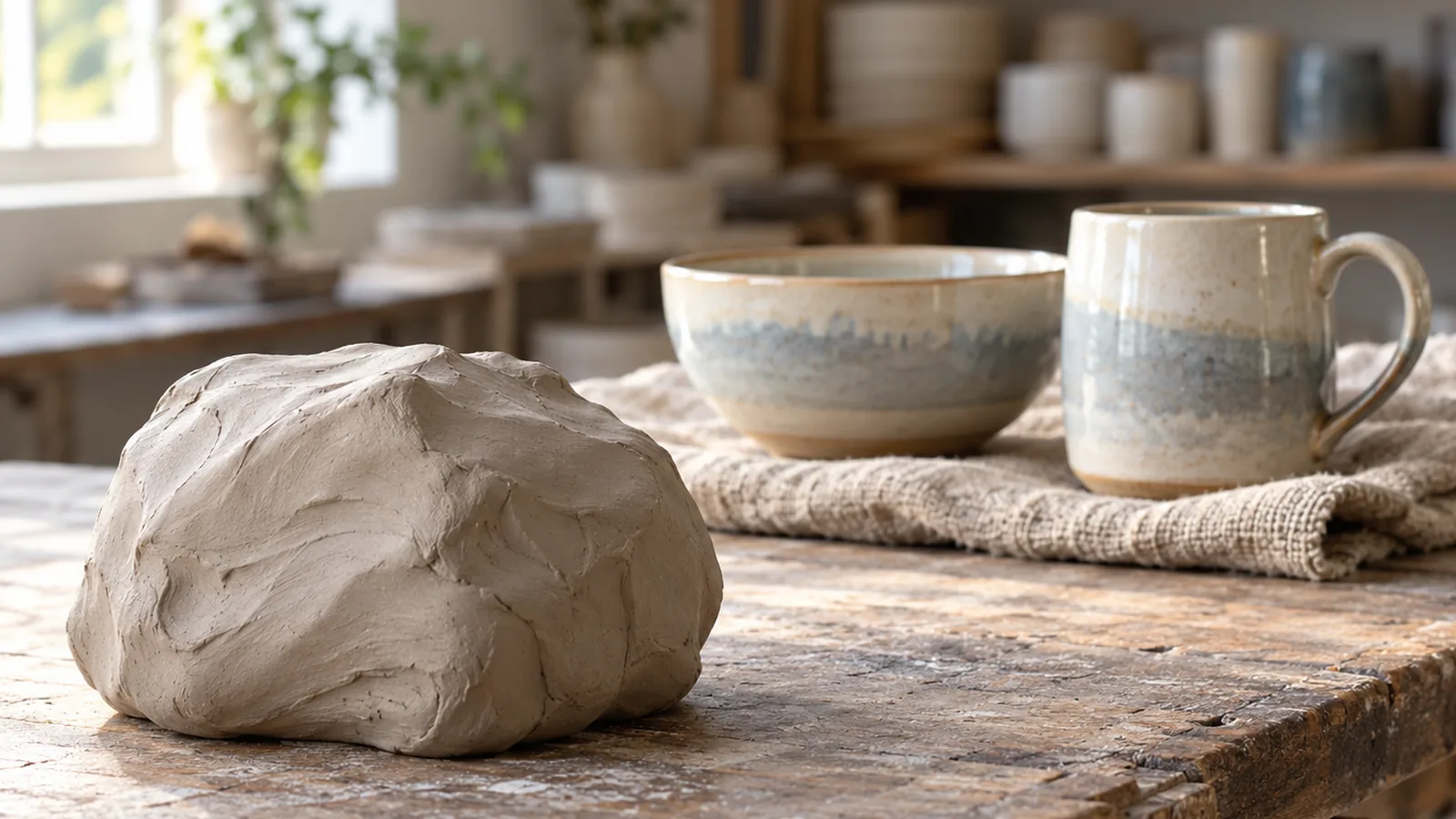
The difference between ceramic and clay is usually whether the material has been fired: clay is workable before firing, while ceramic usually means shaped ware fired to the required heat. Cone 06–10 covers the broad low- to high-fire ranges used for pottery, but the right heat depends on the clay body. Earthenware, stoneware, and porcelain can name either an unfired body or finished ware.
Your choice depends on the body’s intended firing range and the finished piece you want. Check the body label before firing; treating every clay as suitable for the same heat can lead to a poor result.
Key Takeaways
- Cone 04 (about 1,063°C or 1,945°F) is a common glaze-fire target for earthenware.
- Cone 5–6 is the usual mid-range stoneware target in studios, with cone 8–10 as the high-fire target.
- 8–12% water absorption is typical for earthenware, making it the most porous of the three fired bodies.
- Porcelain absorbs the least water, while earthenware absorbs the most.
- Lower water absorption generally means a denser, more vitrified body.
Clay and Ceramic at a Glance
The difference between ceramic and clay is mainly the material’s state: clay is usually workable before firing, while ceramic usually refers to the fired ware. A clay body’s ingredients and intended firing range shape the result.
| Term | State | Meaning in pottery |
|---|---|---|
| Raw clay | Before firing | Workable material used to form an object |
| Prepared clay body | Before firing | A formulated blend of clays and other ceramic materials, such as silica and feldspar, made for a forming process, firing range, and fired result |
| Fired ceramic ware | After firing | A shaped clay body transformed by heat into pottery or porcelain |
The names earthenware, stoneware, and porcelain can describe either ware or its unfired clay body. That overlap can make pottery descriptions sound inconsistent: the word may identify a body before firing or the category of the finished piece.
For choosing clay, look beyond the category name. A prepared body is formulated for particular forming and firing conditions, so the label alone doesn’t tell you how it will perform in your kiln. Firing is the step that changes the shaped object into ceramic ware; the suitable heat depends on the body. When comparing materials, check the body’s intended firing range and the properties of its fired result rather than treating “clay” and “ceramic” as names for competing materials.
Round 1: What Does Firing Change?
At firing, clay is exposed to the heat needed to transform it into pottery or porcelain.
Before firing, the object is still made from clay, even if its body was prepared for a particular firing range and result. After firing, it qualifies as pottery or porcelain. The distinction is about whether the shaped object has undergone the required heat, not simply what name you give its clay body.
The heat required depends on the clay body.
Firing range matters because each clay body is formulated for a specific firing temperature, forming process, and fired result. At any range, heat transforms the shaped object, and the firing schedule must suit the body. A general guide groups firing into low-fire, mid-range, and high-fire ranges, though those ranges aren’t universal limits for every body.
Select a clay body suited to the forming process and firing range you plan to use.
Round 2: Which Firing Range Applies?
Most clay bodies fall into three general firing ranges, and each range suits different ware types.
| Firing range | Cone range | Ware types usually fired |
|---|---|---|
| Low fire | Cone 06–2 | Earthenware |
| Mid-range | Cone 3–7 | Stoneware, porcelain |
| High fire | Cone 8–10 | Stoneware, porcelain |
These ranges are general, not universal limits for every body, so check the firing range on your clay body’s label before you load the kiln.
Cone 5–6 for stoneware is the usual mid-range target in studios, and cone 8–10 is its high-fire target. Porcelain can be formulated for either schedule but is often fired at cone 8–10. Stoneware and porcelain appear in two rows, so the body label matters more than the category name. Earthenware stays in the low range because it remains porous after firing.
Pick the range your kiln reaches reliably, then buy a body labeled for that range, since each body is formulated for a firing range and fired result. Go to high fire when you want a denser, less porous piece, because lower water absorption generally indicates a more vitrified body.
Round 3: How Do Ware Types Fire?
Ceramic and clay can describe different stages of the same material: earthenware, stoneware, and porcelain can refer to either unfired clay bodies or finished ware. Their firing schedules vary by body and studio, so choose a ware that fits your kiln’s firing range.
- Earthenware: It’s typically low-fired, with cone 04 (about 1,063°C or 1,945°F) a common glaze-fire target. Its low-fire schedule suits studios that fire in that range, but it isn’t the right fit if your work needs to mature at a higher temperature.
- Stoneware: It’s commonly fired at cone 5–6 in mid-range studios or cone 8–10 at high fire. That gives you two common firing options, depending on the body and the studio’s schedule.
- Porcelain: It can be formulated for mid-range or high-fire schedules, and it’s often fired at cone 8–10. Check the body’s intended range before choosing a schedule, since formulations differ.
Best fit depends on your kiln. Choose earthenware for a typical low-fire schedule, stoneware for a common mid-range or high-fire option, and porcelain when its formulation matches your studio’s schedule. Among these three, porcelain offers the stated flexibility to be formulated for either mid-range or high-fire firing, while earthenware is typically low-fired.
Round 4: Which Fired Body Absorbs Less Water?
Porcelain absorbs the least water and earthenware absorbs the most.
| Fired body | Typical water absorption (%) |
|---|---|
| Porcelain | 0–1 |
| Stoneware | 2–3 |
| Earthenware | 8–12 |
Lower absorption generally means a denser, more vitrified (glassy and less porous) body. Because it soaks up more liquid, it is less reliably watertight unless its glaze stays intact, so a chip or crack in the glaze matters more.
Absorption alone does not show which body is strongest, so don’t use this table to rank strength.
Frequently Asked Questions
Can ceramic be turned back into clay?
No, firing is the change that turns shaped clay into ceramic ware, so the fired piece isn’t workable clay again. To make something new, start with fresh clay body, since each body is formulated for a particular forming process and firing range. Match that label to your kiln before you buy.
Why does my clay crack during kiln firing?
Start by checking that the body’s firing range matches your kiln schedule, because each body is formulated for a specific range and fired result. Compare the body label with the cone your kiln actually reaches.
What does a cone number mean in kiln firing?
A cone number is a firing target, and the ranges group them: cone 06–2 is low fire, cone 3–7 is mid-range, and cone 8–10 is high fire. Cone 04 is a common earthenware target, at about 1,063°C (1,945°F). Choose the cone that matches your clay body’s label, since the ranges are general, not universal limits.
What is bisque firing compared to glaze firing?
Glaze firing is the firing used once ware is glazed, with cone 04 (about 1,063°C or 1,945°F) a common earthenware target. Match the body to that schedule, since each body is formulated for a specific firing range and fired result.
Does fired clay stay waterproof without glaze?
No, earthenware remains porous after firing and depends on an intact glaze to hold water.
Conclusion
If your kiln reliably reaches cone 6, pick a clay body labeled for that range and skip any body that needs a hotter schedule. If you want pieces that hold up to water without depending on the glaze, choose a body that fires dense, which usually means stoneware or porcelain.
Sources
- Techno File: Clay-Glaze Interface (ceramicartsnetwork.org)
- amoca.org
- Glossary | CT Ceramics Circle (cceramicsc.org)
- filestore.scouting.org
- cerritos.edu
- Earthenware, stoneware, porcelain — what's the difference? | CMW (my.ceramicmaterialsworkshop.com)