
Skutt vs Paragon Kilns: Which Should You Choose?
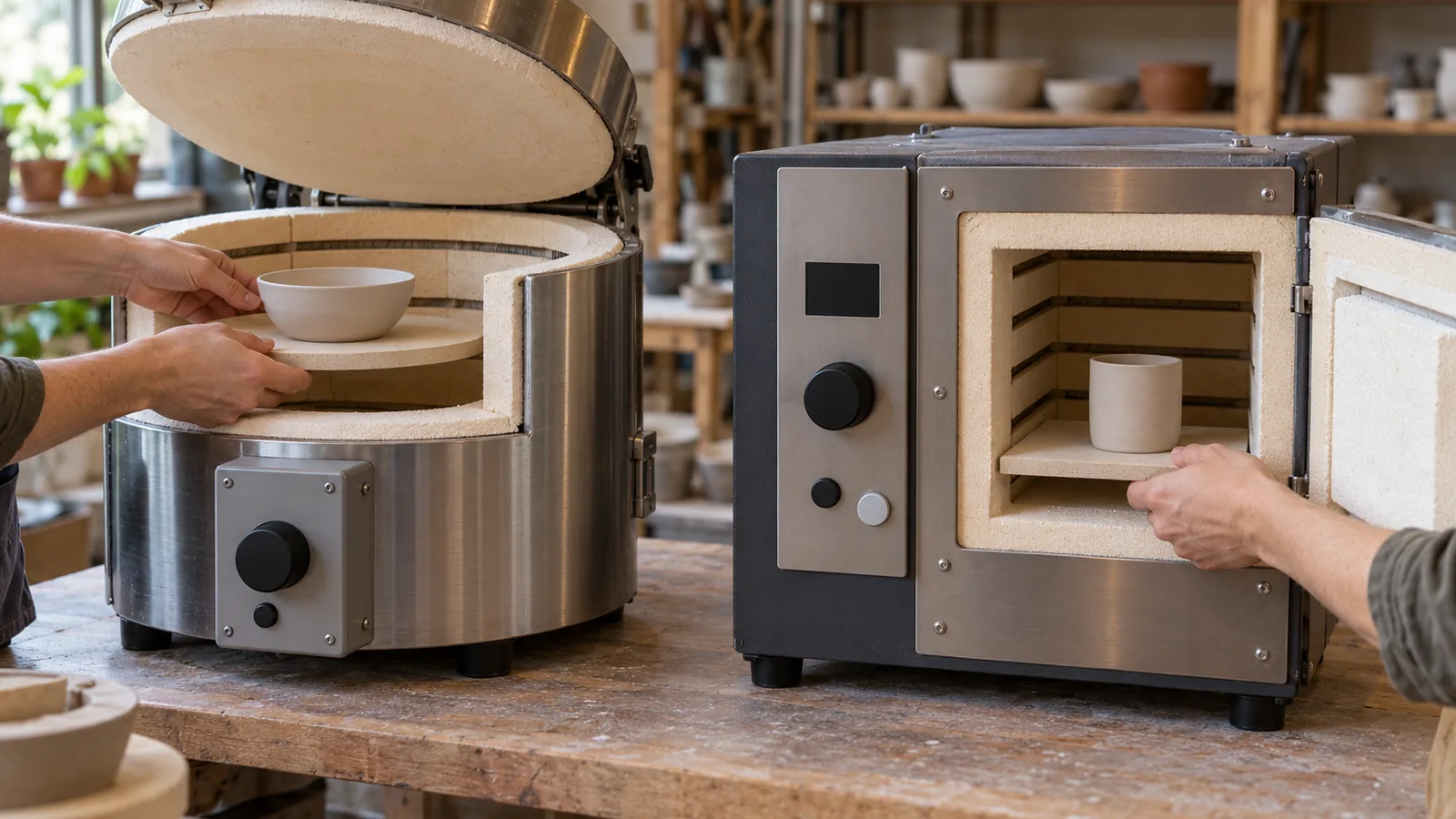
For skutt vs paragon kilns, the Paragon TnF-27-3 lists 8.11 cu. ft. of capacity, compared with 7.0 cu. ft. for the Skutt KM-1027. If kiln capacity is your deciding factor, the listed figures favor the Paragon; compare other features before choosing between these models.
ft. Compare chamber shape, firing needs, and exact model specifications to find the kiln that fits your work and electrical setup.
Which should you choose, Skutt or Paragon kilns?
Quick answer: Neither brand is a universal winner: compare the exact model’s firing rating, chamber dimensions, electrical requirements, controls, and warranty before buying. The Skutt KM-1027 and Paragon TnF-27-3 are both rated for Cone 10 at 2350°F in their 240 V configurations. Choose the TnF-27-3 if its larger listed capacity suits your work; choose the KM-1027 if its chamber shape or documented controller features fit better.
- More listed capacity: The TnF-27-3 has 8.11 cu. ft.; the KM-1027 has 7.0 cu. ft.
- More chamber depth: The KM-1027 is 27 in. deep; the TnF-27-3 is 22.25 in. deep
- Electrical check: Confirm the selected kiln’s voltage, circuit, and connection before installation; the TnF-27-3 listing has conflicting electrical figures
- Firing condition: If considering the KM-1027 in 208 V, its listed rating is Cone 6/2250°F, not Cone 10/2350°F
Which kiln specifications should you compare?
Compare chamber capacity, usable dimensions, firing rating, and electrical requirements for the exact models and voltage you’re considering. For the KM-1027 and TnF-27-3 in their 240 V configurations, the Paragon chamber has greater stated capacity, while both are listed for Cone 10 firing.
| Model | Capacity (cu. ft.) | Chamber dimensions (in.) | Firing rating (°F) |
|---|---|---|---|
| Skutt KM-1027 | 7.0 | 23 × 23 opening, 27 deep | Cone 10 / 2350 |
| Paragon TnF-27-3 | 8.11 | 28 diameter, 22.25 deep | Cone 10 / 2350 |
Capacity and chamber shape tell you different things: check the opening and depth against your largest work, not just the total volume. Voltage also matters to firing capability: Skutt lists the 208 V single-phase KM-1027 at Cone 6/2250°F, below the 240 V version’s stated Cone 10/2350°F rating.
Confirm electrical details for the specific unit before installation. The TnF-27-3 listing gives conflicting amperage and wattage figures, along with different plug and receptacle designations in its description and specification table. Verify the nameplate and connection with the seller or a qualified electrician. Compare the kiln’s required voltage, phase, current, and connection with your available circuit; figures may differ by configuration.
How do Skutt and Paragon models compare?
Skutt vs Paragon kilns compare closely in firing rating, but the listed models differ in chamber size and have conflicting electrical figures. The Skutt KM-1027 and Paragon TnF-27-3 are top-loading kilns rated to Cone 10, or 2350°F, in their 240 V configurations.
- Capacity: The KM-1027 holds 7.0 cu. ft., while the TnF-27-3 holds 8.11 cu. ft.
- Chamber shape: The KM-1027 measures 23 × 23 in. at the opening and 27 in. deep; the TnF-27-3 is 28 in. in diameter and 22.25 in. deep. Skutt says its model can fire a pot up to 23 in. tall or hold a platter up to 21 in. wide.
- Electrical draw: The KM-1027’s 240 V, single-phase configuration is listed at 48 A and 11,520 W. The TnF-27-3 listing gives 48 A and 11,500 W in its description, but 50 A and 12,000 W in its specification table.
For a taller pot, the KM-1027’s stated chamber depth may be useful; for more chamber volume, the TnF-27-3 has the larger listed capacity. Compare the chamber dimensions with your shelves and work, since the models’ shapes differ.
Check the exact TnF-27-3 unit’s nameplate and connection before arranging installation: its listing conflicts on amperage and wattage, and names a NEMA 6-50P cord in one place and a NEMA 6-50R in another. The listed 208 V, single-phase KM-1027 is rated for Cone 6/2250°F, rather than the 240 V version’s Cone 10/2350°F rating. Match the kiln’s voltage and firing rating to your available electrical supply and intended work before choosing.
What differs in controls and ownership support?
Controls and ownership support vary by model, so check the exact controller, warranty terms, service options, and replacement parts before you buy. For skutt vs paragon kilns, one Skutt model has a confirmed controller, and Paragon has service resources, but the details don’t support a like-for-like comparison.
The Skutt KM-1027 uses the KilnMaster controller, which supports up to 32 ramp-and-hold segments and stores up to 12 programs. The TnF-27-3’s controller features aren’t specified, so compare the manuals for your specific models if programming matters to your choice.
Warranty details also need a model-specific check. Skutt says its kiln warranty covers parts and labor and isn’t prorated, but the KM-1027 information available here doesn’t state the warranty duration. A Paragon manual gives a 1-year warranty for Home Artist kilns rated to 2000°F; that doesn’t confirm the TnF-27-3’s warranty term. Don’t apply that term to the TnF-27-3 without confirming it for the selected kiln.
For ownership support, Skutt describes sectional construction on the KM-1027, allowing sections to be separated for moving, repair, or replacement. Paragon provides ceramic-kiln instruction and service manuals and lists replacement elements by kiln model or by part and serial number. These details show available support resources, but they don’t establish response times, local service coverage, or parts availability for a particular buyer.
Before ordering, get written confirmation of:
- Controller: features and operating instructions for the exact model.
- Warranty: duration, covered parts and labor, and how to request service.
- Parts and repairs: which parts are available and how to identify the correct replacements.
Treat these as questions to resolve with the manufacturer or seller, not as confirmed differences between every Skutt and Paragon kiln.
Which brand is the better fit for your needs?
Choose by matching the exact kiln model to your firing needs and electrical supply. For the skutt vs paragon kilns comparison, the KM-1027 and TnF-27-3 provide a useful like-for-like starting point: both are top-loading and listed for Cone 10 at 2350°F in their 240 V configurations.
If chamber room is your deciding factor, the TnF-27-3 lists 8.11 cu. ft. of capacity, while the KM-1027 lists 7.0 cu.
ft. The chambers have different shapes, so compare their dimensions with the work you plan to fire: the KM-1027 is 23 × 23 in. at the opening and 27 in.
in diameter and 22.25 in. deep. Capacity alone won’t tell you what fits.
Check the electrical details against your installation before choosing. The KM-1027’s listed 240 V, single-phase configuration is 48 A and 11,520 W. The TnF-27-3 listing gives conflicting electrical figures and cord details, so confirm the selected unit’s nameplate and connection requirements before installation. For a 208 V supply, the KM-1027’s firing rating differs from its 240 V rating: Skutt lists the 208 V single-phase version at Cone 6/2250°F.
Controls and support can also guide your choice. Skutt lists diagnostics and a KilnMaster controller with up to 32 ramp-and-hold segments and 12 stored programs for the KM-1027. Paragon provides ceramic-kiln manuals and lists replacement elements by model or by part and serial number. Verify warranty terms for the exact model: the cited Paragon warranty applies to Home Artist kilns rated to 2000°F, not the TnF-27-3, and the KM-1027 page excerpt gives no warranty duration.
Frequently Asked Questions
Are Skutt and Paragon kilns suitable for pottery and ceramics?
Yes, both brands make ceramic kilns, and the Skutt KM-1027 and Paragon TnF-27-3 are top-loading models rated for Cone 10 at 2350°F in their 240 V configurations. Check the exact model’s firing rating and chamber dimensions against your clay, glaze, and largest pieces before buying.
What warranty coverage comes with Skutt and Paragon kilns?
Confirm the duration and terms for your exact model: Paragon’s cited 1-year warranty applies to Home Artist kilns rated to 2000°F, not necessarily the TnF-27-3.
Where can I buy replacement elements for Skutt and Paragon kilns?
You can use Paragon’s replacement-element listings to identify parts by kiln model or by part and serial number. Match the element to the exact kiln before ordering, and check with the manufacturer or seller for the correct source and part number for a Skutt kiln.
Do Skutt and Paragon kilns need special ventilation?
Follow the installation instructions for your specific model and check the manufacturer’s manual and local requirements for ventilation. Check the manufacturer’s manual and local installation requirements before placing or connecting a kiln, since the available model details don’t specify ventilation requirements for these kilns.
How much does it cost to run a Skutt or Paragon kiln?
Your running cost depends on the kiln’s electricity use, your electricity rate, and how often and how long you fire. The KM-1027’s listed 240 V, single-phase configuration is 11,520 W; the TnF-27-3 listing gives conflicting figures of 11,500 W and 12,000 W. Confirm the Paragon unit’s nameplate before estimating its cost.
Conclusion
If you need more listed chamber volume, consider the Paragon TnF-27-3; if your work needs more depth or you want the KM-1027’s documented controller features, consider the Skutt. Compare the chamber shape with your largest pieces, then confirm the exact model’s electrical requirements, warranty, and service terms before ordering. For the TnF-27-3, get the electrical details in writing and have them checked against your available circuit.
Sources
- KM-1027 – Kilns | Ceramic Pottery Kiln, Glass Kiln, Pottery Wheels | Skutt (skutt.com)
- sheffield-pottery.com (sheffield-pottery.com)
- corp.paragonweb.com (corp.paragonweb.com)
- corp.paragonweb.com (corp.paragonweb.com)
- paragonweb.com (paragonweb.com)