Is Reactive Glaze Safe for Pottery?
Yes, reactive glaze can be food safe. “Reactive” describes the glaze’s appearance, while safety depends on testing; the Consumer Product Safety Commission recommends testing finished pottery intended for food use. A food-safe label applies only when the glaze is properly applied and fired, so it may not cover mixed glazes or changed production conditions.
Quick answer
Is reactive glaze safe for pottery?
Yes, reactive-glazed pottery can be food safe. “Reactive” describes the glaze’s appearance, while safety depends on testing. Test the finished ware for lead and cadmium if it will be used for food and you lack reliable evidence for that exact glaze, application, and firing. A “food safe” label applies only when the glaze is properly applied and fired, and may not cover mixed glazes or changed production conditions.
- Buying a piece: Ask whether the safety claim applies to the finished ware and its actual production conditions.
- Making or selling pottery: Arrange testing when you lack results for the finished ware or change the glaze, clay body, decoration, or firing.
- Using a test result: Apply it to the submitted samples and test conditions, not to later batches or changed pieces.
How Reactive Glaze Creates Its Visual Effects
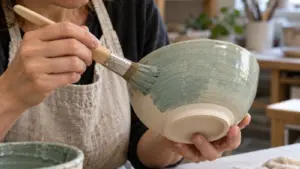
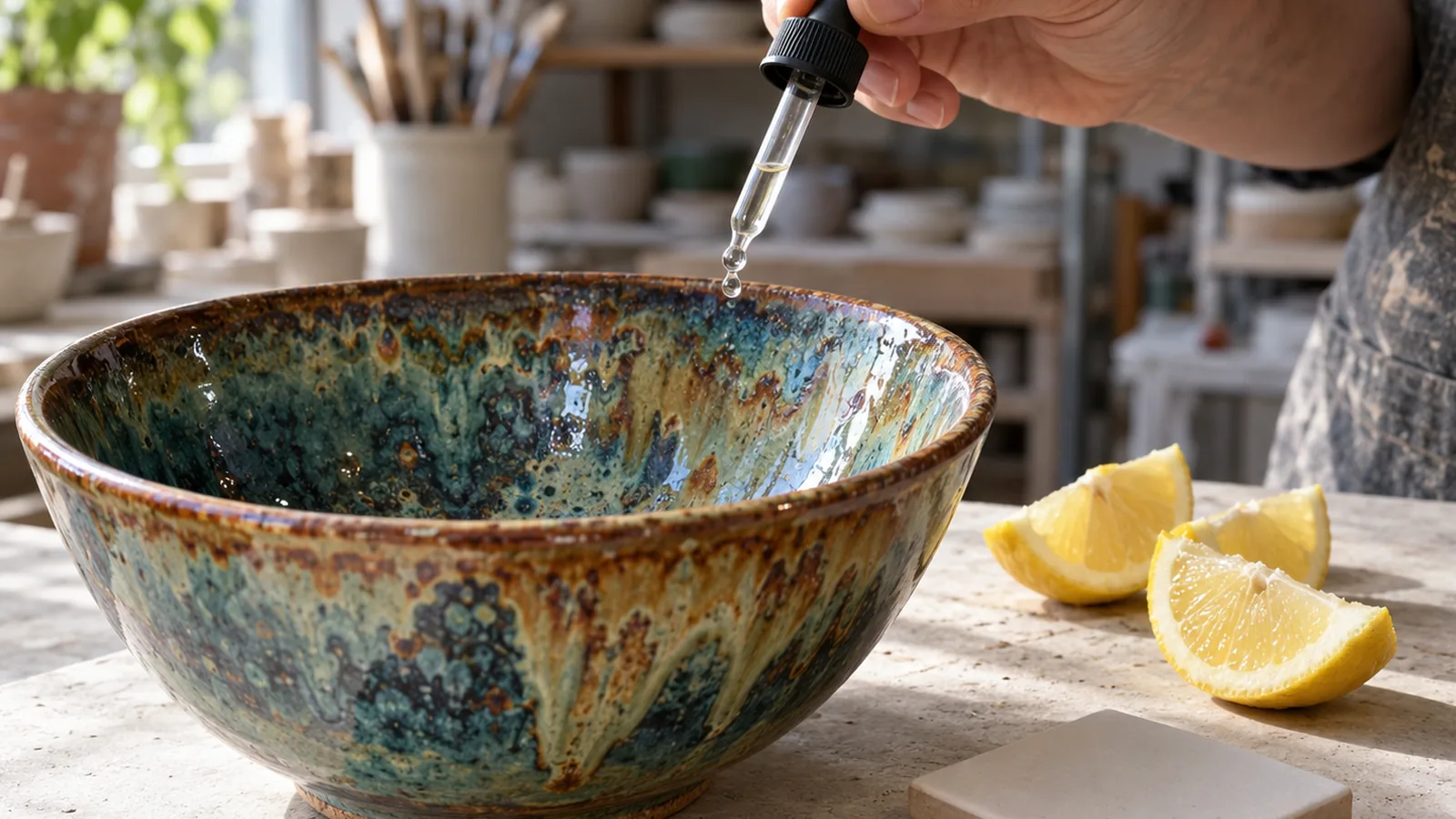
Reactive glazes create visual variation in the fired surface, including layered color, speckling, pooling, and tonal movement. These effects give the glaze a changing appearance rather than a single, uniform color.
That variation is a design feature, not a safety signal: the appearance alone does not tell you whether the surface is suitable for food contact. A vivid pool of color, speckles, or shifts in tone cannot establish whether the finished piece meets food-safety requirements.
Does a Food-Safe Label Guarantee the Finished Pot Is Safe?
No. A “food-safe” label applies only when the glaze is properly applied and fired, and mixing glazes can disrupt the ingredient balance the claim depends on.
Check that the safety claim covers the finished ware under its actual production conditions, including the glaze application and firing used for the piece. A label or claim for a glaze on its own doesn’t establish that a pot made with it will meet the same conditions.
The same caution applies when you change how the glaze is applied or fired: the claim needs to match those conditions.
For pottery intended for food, use evidence from testing the finished piece when you need to verify safety. The Consumer Product Safety Commission recommends testing finished ware; its guidance explains that a “food safe” label doesn’t establish that ware is lead-free. Properly applied and fired ware should not leach lead or cadmium above FDA-allowed concentrations. A passing test applies to the samples and conditions tested, so it doesn’t establish that a later batch or changed process will perform identically.
If you’re buying a piece, ask whether the safety claim covers the finished ware, rather than just the glaze material. If you’re making or selling pottery, seek testing when you change the glaze, clay body, decoration, or firing conditions, or lack reliable test evidence for the finished ware.
Which FDA Limits Apply to Lead and Cadmium?
FDA sets separate action levels by ceramicware category for lead and cadmium, so check the guidance for the type of piece rather than applying one number to every shape. The applicable level depends on how FDA classifies the ware; a lead level does not tell you the cadmium level.
For lead, use FDA’s ceramicware guidance to identify the action level for the category that fits the piece. For cadmium, check FDA’s separate pottery and ceramicware guidance, which lists levels by category. Lead and cadmium have separate guidance; use each metal’s own threshold.
Important
FDA action levels are enforcement thresholds, not permission to allow contamination that can be avoided.
FDA describes action levels as levels at or above which it will take legal action to remove products from the market. The levels account for the unavoidability of contaminants; they do not make avoidable contamination acceptable. A threshold is not a safety target for glaze formulation or production.
For a specific piece, first establish its intended foodware category, then compare the relevant test result with the matching FDA guidance for each metal. A result for one category doesn’t prove safety for a differently classified shape, because FDA’s action levels vary by category. If you can’t determine the correct category or find the applicable level, a general lead or cadmium figure may not apply.
FDA’s cadmium guidance also identifies acidic foods as capable of extracting cadmium from ceramicware. Continued food use of ware with significant extractable cadmium could cause chronic cadmium poisoning. That risk is a reason to assess the finished ware against the relevant cadmium guidance, not to rely on a glaze’s appearance or a general label.
Can Acidic Foods Increase Metal Leaching?
Yes. Acidic foods can extract cadmium from ceramicware, and continued use of ware with significant extractable cadmium could lead to chronic cadmium poisoning. Acid can extract cadmium.
How much metal migrates depends on the glaze and the conditions of contact. A study of ceramic food-contact materials found migration varied with pigment, pH, acid type, and temperature. That means a result for one glaze or test condition shouldn’t be treated as proof that every acidic food is safe with the same piece.
For ceramics fired at 900 °C, migration rose with temperature. This finding applies to the study’s tested materials and conditions; it does not establish a universal rate for all pottery or glazes.
A specific safety claim needs evidence for the finished ware, rather than an assumption based on the glaze’s name or look.
If you make pottery for food use, testing the finished piece can help assess the actual ware rather than relying on a general claim about a glaze. Keep in mind that the study’s temperature finding is specific to ceramics fired at 900 °C, and its other results show why one test condition may not represent every food-contact situation.
Why Can’t One Firing Temperature Guarantee Safety?
Firing affects how a glaze performs, but no single firing temperature or kiln atmosphere guarantees low leaching across different glaze recipes.
The result depends on the specific glaze and how it was fired; a temperature that works for one recipe can’t be treated as a safety setting for another. A study of ceramic food-contact materials found that metal migration varied with pigment, acidity, acid type, and temperature. For ceramics fired at 900 °C, migration increased approximately linearly as temperature rose, but that finding does not establish a safe firing temperature for all glazes.
Firing is one factor, not a universal safety test. Use the firing conditions specified for your glaze, and don’t infer food-contact safety from the kiln temperature or atmosphere alone. If the recipe, clay body, decoration, or firing conditions change, treat the finished ware as a different setup rather than carrying over an earlier safety result.
When Should You Test a Finished Piece?
Test a finished piece whenever it’s intended or could reasonably be used for food, including pottery you sell or give away. Test the finished ware, since a glaze label alone doesn’t establish how the completed piece performs under food-contact testing.
Professional testing is especially relevant if you don’t have reliable test evidence for the specific ware, or if you change any part of its production. Recheck after changing:
- Glaze: a new glaze or altered recipe.
- Clay body: a different body.
- Decoration: added or changed decoration.
- Firing: changed firing conditions.
If any of those change, test representative finished ware again to check whether the earlier result still applies.
Ask a qualified testing lab to assess the finished pottery for lead and cadmium release using an appropriate method for food-contact ceramicware. The FDA’s laboratory method describes analysis of cadmium and lead extracted from ceramic foodware, giving a basis for discussing the test with a lab. Make sure the submitted pieces represent the ware you plan to sell or give away, including relevant glaze, decoration, shape, and firing conditions.
Keep the test report tied to the specific production details and samples it covers. If you can’t show that a new piece matches the tested ware, treat the old result as insufficient evidence for that piece.
Common Myths About Reactive Glaze Safety
The common myths are that reactive glaze means food safe, that food-safe ware must be lead-free, and that a label guarantees safety under any conditions. The finished piece’s application and firing matter.
| Myth | Evidence |
|---|---|
| “Reactive” means the glaze is food safe. | “Reactive” describes visual variation, such as layered color or speckling; it is not a food-contact safety rating. |
| “Food safe” means lead-free. | A food-safe claim does not mean lead-free; properly applied and fired ware should not leach lead or cadmium above FDA-allowed concentrations. |
| A “food safe” label guarantees safety regardless of application and firing. | The claim depends on how the glaze is applied and fired, and mixing glazes can disrupt ingredient balance. The claim needs to apply to the finished ware and its actual production conditions. |
Treat a label as conditional, not as proof that every piece made with that glaze is safe. Changes to the glaze or production conditions can affect whether the finished ware matches the basis for a safety claim. A passing result applies to the submitted samples under the specified test and comparison criteria, so it doesn’t establish how later batches or altered pieces will perform.
Frequently Asked Questions
Does reactive glaze mean a pottery piece contains lead or cadmium?
No. “Reactive” describes a fired glaze’s visual variation, not whether it contains lead or cadmium or meets food-safety requirements. Appearance can’t verify safety; check for evidence covering the finished piece and its actual application and firing.
Are crazed, chipped, or rough reactive-glazed surfaces safe to use?
A glaze’s reactive appearance doesn’t establish whether a damaged or rough surface is safe for food use. Check food-safety evidence for the finished ware, matching its glaze application and firing; a label for glaze material alone doesn’t prove the ware is food-safe.
Should reactive glaze go inside a mug or only on the outside?
Put reactive glaze inside a mug only if the safety claim covers the finished ware with that glaze application and firing. The glaze’s look isn’t a safety rating, so a food-safe claim for the glaze alone doesn’t verify the completed mug.
Is reactive-glazed pottery dishwasher- or microwave-safe?
A reactive glaze’s visual effect doesn’t establish whether a piece is dishwasher- or microwave-safe. Check the maker’s care instructions for the specific piece; food-contact evidence addresses the finished ware’s leaching performance, not dishwasher or microwave use.
Can I use a reactive-glazed mug or bowl for food and drinks?
Yes, if evidence supports the finished piece under its actual glaze application and firing. Reactive describes appearance, not food-contact safety, and a “food safe” glaze label alone doesn’t verify the completed mug or bowl.
Conclusion
If you’ll use the piece for food, choose it only when the safety evidence covers the finished ware and its actual glaze, application, and firing. If that evidence is missing or the production details have changed, keep it out of food use until a qualified lab tests representative finished pieces for lead and cadmium release. Ask for the test report and confirm that its samples match the piece you’re considering. Appearance and a general “food safe” label aren’t enough to make that decision.
How We Researched This
We built this page from 9 sources across 4 publishers, 6 of them official or primary records, led by U.S. Food and Drug Administration, Food and Chemical Toxicology, Fenn Home and U.S. Consumer Product Safety Commission.
- Each figure names its own source, and its year where the source gives one.
- Where sources disagree, the article reports both figures with their sources instead of averaging them.
- We used published records and maker or agency pages only; we did not run tests or surveys, and figures can change after publication.
Sources
- Reactive Glaze Tableware: Sampling & Production Guide (fennhome.com)
- cpsc.gov (cpsc.gov)
- Elemental Analysis Manual – Section 3.2 (fda.gov, Tue, 02 Jun 2020 17:57:02)
- fda.gov (fda.gov)
- CPG Sec 545.400 Pottery (Ceramics); Import and Domestic – Cadmium Contamination (fda.gov, Thu, 03/06/2025 – 21:47)
- Guidance for Industry: Action Levels for Poisonous or Deleterious Substances in Human Food and Animal Feed (fda.gov, Tue, 10/01/2024 – 07:01)
- sciencedirect.com (sciencedirect.com)
- sciencedirect.com (sciencedirect.com)