How to Mix Dry Glaze Powder for Ceramics
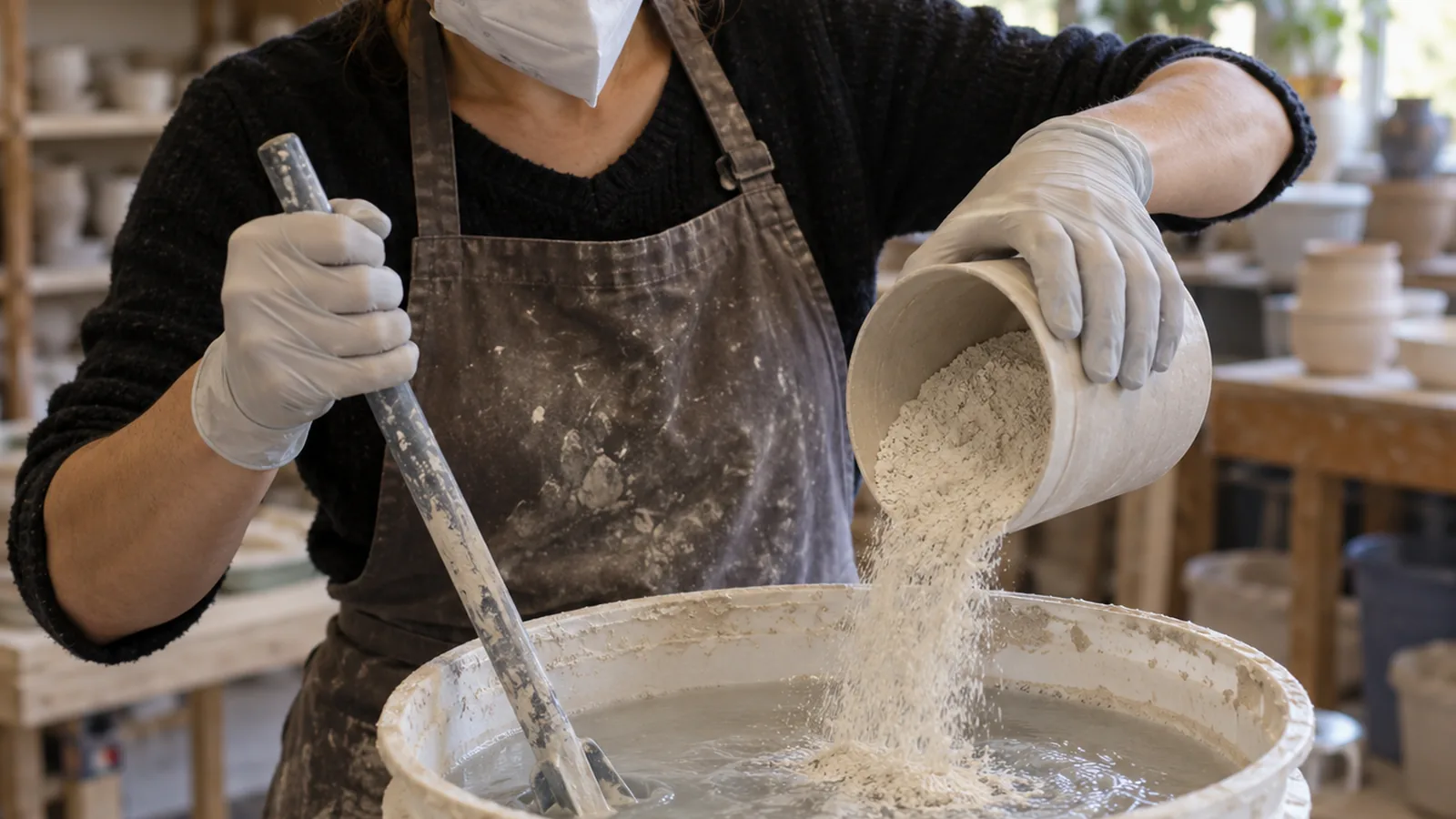
Mix dry glaze powder using the water amount specified for that product, then blend it in the stated order and for the stated time; AMACO’s sequence starts with 1 gallon of water. Water amounts and mixing steps vary by glaze, so don’t use one product’s ratio or timing for another. Keep a NIOSH-approved respirator on while dry glaze dust is present.
How do you mix dry glaze powder?
Quick answer: Add the water in the amount and order specified for your glaze, then mix and prepare it as directed; there’s no universal water ratio. Keep a NIOSH-approved respirator on whenever glaze dust is present.
- Read the glaze label and safety directions before opening the powder.
- Gather a clean container, water, and mixing tools; for Mayco dry glaze, agitate the powder in its bag before measuring.
- Measure the water using that glaze’s directions. Mayco’s general starting measure is 1 pint per 1 pound, but Stoneware Clear calls for 4–5 pints per 5-pound bag.
- Add ingredients in the directed order: Mayco puts water in the bucket first, while AMACO starts by slowly adding water to the dry glaze.
- Prepare the mixture as directed: AMACO’s sequence includes a 20-minute soak and a 30-minute mix; Mayco says to let the glaze settle and saturate, then mix until incorporated.
Mix and prepare the glaze
Mayco’s sequence starts with water in a clean bucket. Use the steps for your glaze, since mixing order and preparation details differ by manufacturer.
- Read the label and safety directions. Check the product’s mixing sequence and any handling or cleanup precautions before opening the powder.
- Gather a clean container, water, and mixing tools. For Mayco dry glaze, agitate the powder in its bag before measuring it.
- Measure water using the product’s directions. Don’t substitute another glaze’s ratio: Mayco’s general starting measure differs from its Stoneware Clear product instruction.
- Add the ingredients in the directed order. Mayco says to put water in the bucket first, then gently add the powder; AMACO’s sequence starts by slowly adding water to the dry glaze.
- Mix and prepare the glaze as directed. Mayco says to let the glaze settle and saturate, then mix until incorporated. AMACO specifies the timed steps below.
| Preparation step | Time |
|---|---|
| Soak after adding water | 20 minutes |
| Initial mix | 30 minutes |
| Hydrate after optional sieving | At least 12 hours |
| Remix after hydration | 10 minutes |
AMACO’s sequence applies to its glazes, so don’t use its timings for another brand’s glaze. Sieving depends on the glaze: Mayco says its dry glazes don’t need it, while AMACO gives optional general sieving advice and recommends a different mesh size for DL-25.
- Check the glaze’s consistency using its product guidance. AMACO advises comparing specific gravity with the range for that glaze and adding water only as its directions allow.
- Label and store any remaining mixture as directed on the product. Before using mixed glaze again, mix it from the bottom and remix to keep it homogeneous.
How much water should you add?
The right amount of water depends on the specific glaze, so use its product instructions rather than a universal ratio when deciding how to mix dry glaze powder. Published directions differ, even within one maker’s products.
Mayco’s general starting measure is 1 pint of water per 1 pound of dry glaze. But that amount doesn’t work for every glaze: Mayco’s Stoneware Clear instructions call for 4–5 pints per 5-pound bag, while its general measure gives 5 pints for the same amount of powder. Use the amount given for the glaze you’re mixing.
AMACO’s mixing directions give a different example: slowly add 1 gallon of water to the dry glaze. That amount applies to the mixing sequence described in those directions, not to every AMACO glaze or every dry glaze. Check the label or product instructions for the amount and mixing method for your glaze.
If the instructions don’t give a clear water amount, contact the glaze maker rather than treating another product’s ratio as a substitute. Mayco recommends checking specific gravity, a measure of a liquid’s density compared with water, and gives a general target of 1.38–1.42. AMACO, by contrast, says to compare a glaze’s measured specific gravity with the range for that specific glaze, and its DL-25 product page gives a recommended value of 1.52. Those different targets show why a measurement from one glaze shouldn’t be applied automatically to another.
Water quality can also affect mixing: AMACO warns that soluble salts in tap water may cause glaze to clump, settle, or gel. Mayco says distilled water helps avoid adding ingredients, but its instructions don’t prohibit tap water. Check the instructions for your glaze before choosing water or changing the amount.
Check consistency before applying
Check glaze consistency by measuring its specific gravity against the range for that glaze, then adjust only as its maker directs. Specific gravity compares the weight of equal volumes of glaze and water, giving you a repeatable check beyond judging thickness by eye.
Use a scale and two identical containers. Weigh one container filled with water, then weigh the other filled with glaze; divide the glaze weight by the water weight to get the specific gravity. For Mayco glazes, the general target is 1.38–1.42 specific gravity, but use the range for your particular glaze when one is given.
If an AMACO glaze’s specific gravity is above its stated range, add 60 mL (¼ cup) of water at a time, mix, and measure again. Don’t use that adjustment method for another glaze unless its maker allows it. AMACO also describes a raw glaze coating about 1.5 mm thick, roughly the thickness of a dime, as a reference. Treat that as a coating guide, not a replacement for the specific-gravity check.
Before dipping, mix the glaze from the bottom and remix it before each use to keep it uniform. Recheck its specific gravity periodically, since the measurement helps you track consistency as you work.
What safety steps should you follow?
Protect yourself from airborne glaze dust by using a NIOSH-approved respirator whenever dry glaze dust is present, and follow the safety directions for your specific glaze. The CPSC also recommends protective clothing and gloves when handling powdered glazes.
Before opening the powder, read the glaze label and safety directions, and have your water and mixing tools ready. Keep handling focused to avoid spreading dust, and use the respirator while dust is present, including during dry-powder mixing. The CPSC’s guidance calls for these precautions when handling powdered glazes:
- Respirator: Use a NIOSH-approved respirator.
- Clothing: Wear protective clothing.
- Gloves: Wear gloves.
Clean spills of powdered glaze with a wet mop or rags, or a HEPA vacuum, rather than sweeping.
Warning
Keep cleanup wet or use a HEPA vacuum rather than sweeping spilled powder.
If glaze gets on your work area, clean it with the methods above rather than brushing or sweeping it away. Handle and dispose of any remaining glaze according to its product safety directions; specific directions can vary by glaze.
Frequently Asked Questions
How long can mixed ceramic glaze be stored?
Properly mixed and maintained Mayco SD glaze doesn’t expire in the bucket, and AMACO recommends keeping prepared glaze in a sealed bucket. Store it sealed, label the specific gravity and mixing date, and remix it thoroughly before use. Follow your glaze’s storage directions, since the no-expiration statement applies specifically to Mayco SD glazes.
Can you mix only part of a dry glaze package?
Yes, you can mix a portion, but measure water to match the amount of powder using that glaze’s directions. Use the product’s ratio, since Mayco’s Stoneware Clear calls for a different water amount than its general starting measure. Keep the unused powder dry and handle it with the label’s safety precautions.
Can you rehydrate glaze that has dried out?
Yes, dried glaze can be rehydrated by adding water and mixing it according to the glaze’s preparation directions. Use the specified water amount, then check consistency against the glaze’s specific-gravity guidance before applying it. Wear a NIOSH-approved respirator if rehydrating creates or exposes dry glaze dust.
How do you dispose of leftover ceramic glaze safely?
Use the glaze’s product safety directions to handle and dispose of leftover material, since disposal requirements can vary by glaze. Keep powdered glaze out of the air: clean spills with a wet mop, rags, or a HEPA vacuum, not a broom. Wear a NIOSH-approved respirator when glaze dust is present.
How often should you remix glaze before dipping?
Remix glaze from the bottom before each dipping session so settled material is incorporated and the mixture stays uniform. Remix before each use, then periodically check specific gravity to track consistency as you work.
Conclusion
If the glaze gives a water amount and mixing sequence, follow those directions and prepare the batch with the listed tools. If the amount is unclear, pause before adding water and ask the maker rather than using another glaze’s ratio. Keep the respirator on while dry powder is present.
Sources
- 67c856372d9e6 (amaco.com, Wed, 05 Mar 2025 13:48:39)
- maycocolors.com (maycocolors.com)
- cpsc.gov (cpsc.gov)
- maycocolors.com (maycocolors.com)
- shop.amaco.com (shop.amaco.com)