
How to Choose a Pottery Wheel for Your Needs
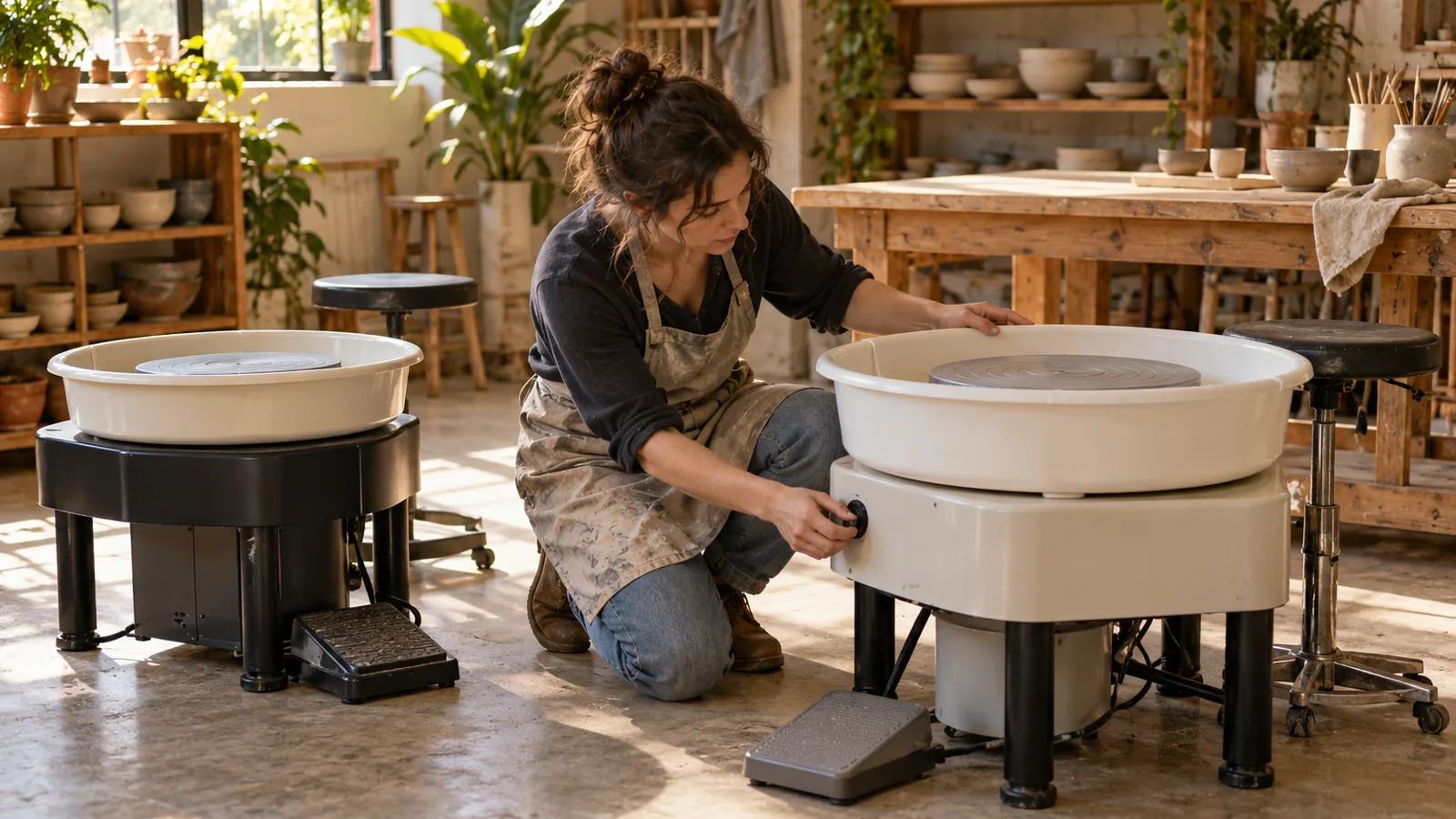
Choose a pottery wheel by matching its form to your workspace and its stated clay capacity to the largest load you plan to center; listed capacities range from 20 lb to 100 lb across some models. For heavier work, compare torque and continuous-duty performance, since advertised capacity figures may not be measured the same way.
Quick answer
How do you choose a pottery wheel?
Match the wheel’s format to your workspace and its stated centering capacity to the largest clay load you expect to use. Compare speed range and control method, then check motor performance, wheel-head size, bat-pin spacing, and power requirements. For larger or heavier work, compare torque and continuous-duty performance, and test with your intended clay load when possible.
- Choose the format: Pick a tabletop wheel if you need to move or store it and have a stable table at a suitable height; choose floor-standing if you want its own frame and working position.
- Set your clay load: Write down your typical and largest loads, then compare them with each model’s stated capacity; those figures aren’t directly comparable unless measured at the wheel head.
- Compare controls: Check the speed range and control method. The Artista is listed at 0–220 rpm with hand control; the ASPIRE is listed at 0–230 rpm with lever or foot-pedal control.
- Check the fit: Compare wheel-head size and bat-pin spacing with your work and bats, then verify working height, dimensions, weight, and voltage for the exact model.
- For heavy work: Compare torque and continuous-duty motor performance, and test the wheel with your intended clay load when possible.
Choose a wheel that fits your work
Choose the wheel’s location. Measure the space where you’ll work and decide whether the wheel can stay set up or needs to be stored. A tabletop model can suit a limited-space studio or classroom, but it needs a separate, stable surface at a suitable working height.
Write down your typical and largest clay loads. Compare the amount you expect to center with each wheel’s stated capacity. For reference, the Speedball Artista is listed at 25 lb capacity, while the Speedball Clay Boss is listed at 100 lb. Treat those figures as model-specific: advertised capacities aren’t necessarily comparable unless measured at the wheel head. For larger or heavier work, also compare torque and continuous-duty motor performance, and test with your intended clay load when possible.
Select the format for your workspace and use. Consider a tabletop wheel if you need a compact setup, can provide a stable surface, and want a wheel intended for clay throwing. The SHIMPO ASPIRE is presented for studio or classroom use and has a listed 20-lb centering capacity; the Speedball Artista is also described for studio and classroom use. Check the specific model’s working height, capacity, and controls, since tabletop models aren’t interchangeable.
Compare the working specifications and features. Check speed range and how you control it: the Artista is listed at 0–220 rpm with hand control, while the ASPIRE is listed at 0–230 rpm with lever or foot-pedal control. Compare motor ratings and features, too: the Clay Boss is listed at 0.5 hp with load-sensing speed control, and the AMACO Brent CXC at 1 hp. Check wheel-head diameter against your work and bats, then verify bat-pin spacing and capacity; head diameter doesn’t set the maximum pot diameter. Before buying, verify the exact model and voltage, since specifications differ.
Match wheel format to your workspace
Choose a tabletop wheel if you have limited floor space or need to store it; choose a floor-standing wheel if you have room for a dedicated setup. Tabletop wheels rely on a separate surface at a suitable height, while floor-standing wheels provide their own frame and working position.
A tabletop model can work for learning, classroom use, or a small studio, but check that the specific wheel is made for throwing clay. Capacity, controls, and working height should fit the learner, and tabletop models aren’t interchangeable in those respects. The SHIMPO ASPIRE and Speedball Artista are both presented for studio or classroom use, with variable-speed control and stated centering capacities of 20 lb and 25 lb, respectively.
If you need to put the wheel away between sessions, tabletop formats are generally easier to move or store than floor-standing formats. Plan for the table too: it needs to provide a stable surface at a comfortable working height, so a tabletop wheel still requires a suitable setup.
A floor-standing model makes more sense when you have a regular workspace and want the wheel’s frame and working position built in. Stability and ease of handling depend on the model’s dimensions and weight, whether it’s floor-standing or tabletop. Check the exact model’s dimensions and weight against your workspace, and verify its intended use and specifications before buying.
Check capacity, controls, and operating features
Compare each wheel’s stated capacity, speed controls, motor, and working features with the clay and forms you expect to throw. Treat capacity as a starting point, then check how the figure was measured and whether the wheel can keep turning under your intended load.
A capacity label alone can mislead: manufacturers’ figures aren’t universally comparable unless measured at the wheel head. Compare the stated capacity with the largest amount of clay you expect to center. These figures describe those models, not a universal threshold for small or large work.
The Artista is listed with hand control from 0–220 rpm; the SHIMPO ASPIRE is listed at 0–230 rpm, with lever or foot-pedal control. Choose a control method you can adjust smoothly while throwing.
Motor ratings also vary by model: the Speedball Clay Boss is listed at 0.5 hp with load-sensing speed control, while the AMACO Brent CXC is listed at 1 hp. Compare motor details alongside capacity and intended use, rather than treating horsepower alone as a measure of suitability.
Before choosing, compare the wheel-head diameter and bat-pin spacing with the bats you expect to use; head diameter alone doesn’t set the maximum pot diameter. Also check rotation direction, splash-pan design, power requirements, dimensions, weight, warranty, and service support. A wheel that fits the clay load still needs to fit your working setup.
Compare pottery wheel types at a glance
The comparison comes down to whether you have room for a dedicated frame or need a wheel that sits on a separate table. Both formats can suit studio or classroom use, but the tabletop option depends on your table and the specific model’s capacity, controls, and working height.
| Format | Workspace and setup | Advantage or trade-off | Suits | Source |
|---|---|---|---|---|
| Tabletop | Sits on a separate table; generally easier to move or store | Requires a suitable table; dimensions, weight, and stability vary by model | Learning, studio, or classroom use when the model’s capacity, controls, and working height fit | speedballart.com shimpoceramics.com |
| Floor-standing | Has its own frame and working position | Dimensions, weight, and stability vary by model | Use where you want a wheel with its own frame and working position | speedballart.com shimpoceramics.com |
Treat “tabletop” as a setup description, not a capacity rating: models differ, so compare the specific wheel’s stated capacity and controls with your work.
Frequently Asked Questions
Can a pottery wheel run in either direction?
Some pottery wheels can rotate in either direction, but the feature isn’t standard on every model. Check whether the specific wheel has a reversing switch or needs a wiring change; if you change direction, stop the motor completely first.
What electrical outlet does a pottery wheel need?
Match the wheel’s voltage requirement to your available outlet before buying, since requirements can differ by model. Check the exact model’s power specifications rather than assuming every wheel uses the same outlet.
How noisy are pottery wheels during use?
Noise levels vary by model, and the available specifications don’t provide a comparable noise rating. If quiet operation matters in your workspace, check the exact model’s noise information and operating features before choosing.
What accessories do I need with a pottery wheel?
Start with bats that fit the wheel head, and check the bat-pin spacing before buying. A splash pan is another useful feature to compare; some models include one, so confirm what comes with the specific wheel.
How do I maintain and clean a pottery wheel?
Remove clay and water from the wheel and splash pan after use, and keep moisture away from electrical parts. Cleaning and maintenance details can vary by model, so use the wheel’s manual for model-specific care instructions.
Conclusion
If you have limited space or need to store the wheel, choose a tabletop model only if you can provide a stable surface at a comfortable height. If you have room for a dedicated setup, choose a floor-standing wheel, then match its capacity and controls to the clay and forms you plan to throw.
Before buying, measure your workspace and write down the largest clay load you expect to center. Compare that with each model’s stated capacity, control method, and working height, then verify the exact model’s specifications.
Sources
- Artista Potter’s Wheel (speedballart.com)
- speedballart.com (speedballart.com)
- shimpoceramics.com (shimpoceramics.com)
- skutt.com (skutt.com)
- shop.amaco.com (shop.amaco.com)
- shimpoceramics.com (shimpoceramics.com)
- sheffield-pottery.com (sheffield-pottery.com)
