What Height Should a Pottery Wheel Be?

There’s no fixed measurement for pottery-wheel height; for seated throwing, set the wheel head slightly below your elbow with your arms relaxed at your sides. Your body and posture determine the fit, so keep your feet flat and sit upright; raised shoulders or hunching can signal that the wheel is too high or too low.
What height should a pottery wheel be?
Quick answer: For seated throwing, set the wheel head slightly below your elbow when your arms hang naturally at your sides; there’s no fixed inch or centimeter target. Sit upright with your feet flat, then check your shoulders: raised shoulders can mean the wheel is too high, while hunching can mean it’s too low.
- Sit in your usual throwing posture with your feet flat.
- Compare your elbow height with the height from the floor to the wheel head.
- Adjust the wheel or seat until you can sit upright with relaxed shoulders.
- If you throw standing, check your posture in your normal stance; available guidance gives differing height references, not one agreed target.
The short answer
Persistent forward bending or a rounded back is a reason to reassess the wheel and seat together.
There’s no single agreed target for standing throwing: one guide places the wheel head around mid-thigh to hip height, while another uses belly-button level. Your body proportions and stance affect the fit, so check your posture at the wheel rather than treating either position as a universal measurement.
How to measure your wheel height
Set up the posture you’ll use. To check what height should a pottery wheel be, sit at the wheel in your usual throwing position, with your feet flat and your back upright. Measure the fit while seated, since the recommended reference point is your elbow in that posture.
Measure from the floor to the wheel head. Use a tape measure to record the vertical distance from the floor to the top of the wheel head. Keep the measurement points consistent if you check the setup again after adjusting the chair or wheel.
Compare the wheel head with your elbow. Let your arms hang naturally at your sides, then compare your elbow height with the wheel-head height. For seated throwing, the wheel head should sit slightly below your elbow; the guidance gives no fixed measurement in inches or centimeters.
Check your posture at the wheel. Sit upright with your feet flat and assess whether your shoulders stay relaxed as you work. Raised shoulders can indicate that the wheel is too high, while hunching can indicate that it is too low. Persistent forward bending or a rounded back is a reason to reassess the wheel and seat fit.
Measure standing setups separately. If you throw standing, check the wheel head against your body in your normal stance, but treat the result as a personal fit check rather than a universal target. One guide places it around mid-thigh to hip height, while another uses belly-button level, so the available guidance does not establish one agreed standing height.
How your height and posture affect the fit
These signs help you judge the fit at the wheel, where your actual posture matters more than a height estimate alone.
Feet flat and shoulders relaxed are useful checks, but the available guidance gives no body-measurement thresholds for deciding how much to change the setup.
Standing posture calls for a separate check: one guide places the wheel head around mid-thigh to hip height, depending on body proportions and stance, while another places it at belly-button level. If standing makes you bend forward persistently or round your back, reassess the height and your position at the wheel.
| Setup | Extension (inches) | Extension (cm) | Platform dimensions (feet) | Platform dimensions (cm) |
|---|---|---|---|---|
| Axner tall leg extensions | 11–22 | 27.9–55.9 | — | — |
| Adjustable lift platform | — | — | 2 × 4 | 61 × 1.2 m |
The Axner extension range is product-specific, not a universal adjustment limit.
Adjust the wheel or your seat
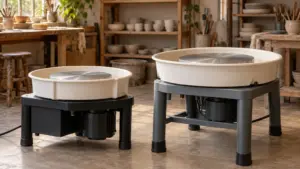
According to CDC, raise a wheel that sits too low with manufacturer leg extensions or a stable support frame; lower an adjustable wheel if it sits too high for seated throwing.
If you can’t change the wheel height, adjust your seat to bring your body into a comfortable throwing position. A seat roughly level with the wheel is one suggested arrangement, but there’s no universal measurement for seat height. Personalize the wheel and stool setup, and consider a seat with lumbar support or tilt adjustment. Seat and stool adjustments can help you avoid working with raised shoulders or a hunched back.
Check the exact lift available before choosing an extension. One Axner manual lists leg extensions that add 11–22 inches. That range applies to those extensions only; the sources don’t set a universal safe adjustment range for pottery wheels.
For a custom lift, one setup uses an electric scissor lift rated for 350 pounds with a ½-inch plywood platform measuring 2 feet × 4 feet. Treat those dimensions and the lift rating as details of that setup, not general specifications for other lifts or platforms. Test the lift without clay through its full height range, and confirm it stays stable at both its lowest and highest positions before throwing.
Frequently Asked Questions
Should my pottery wheel be level with my knees?
No. For seated throwing, set the wheel head slightly below your elbow when your arms hang naturally, rather than using your knees as the reference. Check the fit while sitting upright with your feet flat; raised shoulders or hunching can signal that the wheel is too high or too low.
Can I use a regular chair at a pottery wheel?
Yes, if you can sit upright with your feet flat and keep your shoulders relaxed while throwing. Adjust the chair to fit your posture, then compare the wheel head with your elbow; it should sit slightly below it when your arms hang naturally.
Can I raise a pottery wheel that is too short?
Yes. Check that the wheel head sits slightly below your elbow while seated, and reassess your posture after the change. There’s no universal safe adjustment range, so use only a support suited to your wheel.
What height should a pottery wheel be for a child?
Set the wheel head slightly below the child’s elbow when they’re seated in their throwing posture, rather than choosing a height by age. They should be able to sit upright with their feet flat; raised shoulders or hunching are signs to reassess the wheel and seat together.
Do pottery wheels come in adjustable heights?
Yes, some pottery wheels can be adjusted, though the available height range varies by setup. For seated throwing, lower an adjustable wheel until the head sits slightly below your elbow; if the wheel is too low, manufacturer extensions may raise it. Check the specific wheel’s adjustment options before choosing a support.
Conclusion
Next, sit or stand at the wheel as you work, check your posture, then make a small adjustment and check again.
Sources
- Tips and Tools: Adjustable-Height Wheel (ceramicartsnetwork.org)
- thepotterywheel.com (thepotterywheel.com)
- ceramicartsnetwork.org (ceramicartsnetwork.org)
- axner.com (axner.com)
- stacks.cdc.gov (stacks.cdc.gov)
- ceramicartsnetwork.org (ceramicartsnetwork.org)